
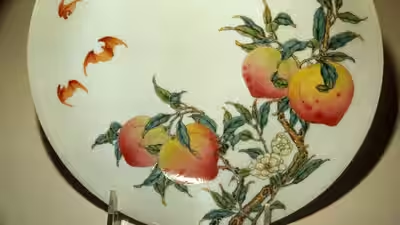
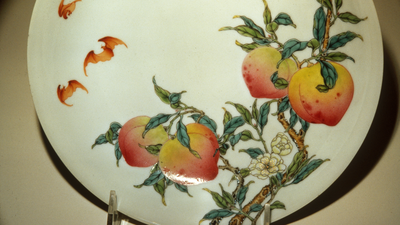
A rare porcelain bowl made by skilled imperial craftsmen during China’s Qing dynasty in the early 18th century has sold for $2.048 million (£1.56 million) at a Christie’s auction in New York. The 14.3-centimetre bowl was made during the short reign of Emperor Yongzheng, which lasted from 1723 to 1735. In the early 20th century, it passed through the hands of a well-known Paris art dealer. It was later bought by a private collector and donated to the Art Institute of Chicago in 1939. The bowl remained in the museum’s collection for 87 years before being put up for auction to raise money for the care and growth of its Asian art collection. According to a press statement from Christie’s, the final sale price was five times the bowl’s lowest pre-sale estimate. The sale was part of a major two-day autumn auction series in New York, which brought in a total of $25.96 million (£19.8 million) from Chinese works of art.
Imperial craftsmanship and artistic technique
The bowl is an example of famille rose porcelain, a style of coloured enamel decoration that was developed to a high level during the Qing dynasty. According to catalogue notes published by Christie’s, the bowl uses a design method known as guozhihua, or “flowering branch passing over the rim”. In this technique, the painted design starts on the outside of the bowl and continues over its rim onto the inside. Creating guozhihua designs on curved porcelain bowls was very difficult for imperial craftsmen because they had only a small, rounded surface to work on. To make the peaches look realistic, the artisans blew fine enamel powders directly onto the glazed ceramic. They then used brushes to add details and create smooth colour changes from pale green to rose pink. The design features six ripe peaches and five red bats shown flying across both the outside and inside of the bowl.
Auspicious symbolism and imperial context
In traditional Chinese imperial art, each image has a deeper meaning. According to Christie’s description of the auction lot, the combination of six peaches and five red bats suggests that the bowl may have been made for Emperor Yongzheng’s birthday.In Chinese art and symbolism:
- Peaches stand for long life. They are linked to the Daoist star god Shou Lao and the legendary orchards of the Queen Mother of the West.
- The number six, or liu, is linked to the idea of keeping or extending a long life.
- Five red bats, known as hong fu, represent the Five Blessings: health, long life, wealth, love of virtue and a peaceful death.
- The phrase guoqiangzhi, meaning “branch passing over the wall”, sounds like guo chang zhi, which translates as “long peace under good government”.
- Because these symbols carry several connected meanings, historians and ceramics experts consider bowls with this combination of designs to be among the finest examples of porcelain made for the Yongzheng court.
Ownership history and auction performance
Before joining the Art Institute of Chicago’s collection, the bowl belonged to C.T. Loo (1880–1957), a leading Chinese art dealer who worked in Paris during the early 20th century. It was later bought by Russell Tyson (1867–1963), a Chicago art collector and supporter of the museum. Tyson donated the bowl to the Art Institute of Chicago, where it was officially added to the permanent collection in 1939. The bowl was offered as a leading item in Christie’s sale titled Important Chinese Art Including Ceramics from the Art Institute of Chicago. Vicki Paloympis, head of the Chinese Ceramics and Works of Art Department at Christie’s in New York, spoke about strong demand for imperial artworks with a clear record of ownership. “This season we had two fantastic sales that showed great results,” Paloympis said in a statement released by Christie’s. “As we have seen in previous seasons, but now more than ever, the strongest results were driven by works that combined superb quality with exceptional provenance.” Paloympis added that the strong interest in items from the Art Institute of Chicago showed that buyers place great value on artworks with well-documented ownership histories. The Art Institute of Chicago will keep the $2.048 million raised from the sale to support future purchases and preservation work across its Asian art department.