
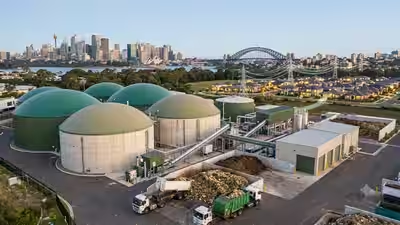
Every day, food that has reached the end of its useful life leaves kitchens, shops, factories and distribution centres across Sydney. Much of it could end up as waste with little further use. At EarthPower in Camellia, that material takes a different route. The facility uses anaerobic digestion to break down organic food waste and capture the biogas produced along the way. That gas is then used to generate electricity, while the remaining material is processed into a soil improver. According to Waste Management Review 2025, EarthPower’s upgraded ‘plate to paddock’ facility has a total capacity of 62,500 tonnes, of which 65% is dedicated to food waste expected to yield roughly 1,500 tonnes of soil improver annually while generating enough electricity to power around 4,000 homes.
How Australia turns food waste into a resource at EarthPower
Australia produces a large amount of municipal waste on a per-person basis, and food makes up a substantial share of it. Food waste is also classed as putrescible waste, meaning it can break down relatively quickly when sent to landfill.EarthPower was established in Sydney’s Camellia suburb as a dedicated alternative for organic waste. Rather than treating discarded food as material with no further purpose, the facility takes in waste from a range of businesses and local government sources and puts the organic content through a recovery process.Its intake is not limited to one type of food waste. Solid organic material, grease trap waste, spadable sludge, organic liquids and selected packaged waste can all form part of the feedstock accepted by the facility.That gives the plant a fairly broad role in the local waste system. Food manufacturers and processors, distributors, retailers, commercial kitchens and other businesses can send material there instead of relying solely on conventional disposal.
Inside Australia’s EarthPower process for turning waste into power
The central part of the operation takes place inside two anaerobic digesters. There is no need for oxygen in this stage. Bacteria break down the organic material inside the digesters, producing biogas as the waste decomposes. The gas is collected rather than released and is directed towards cogeneration engines. Those engines turn the biogas into electricity. In practical terms, the process takes material that would otherwise have been discarded and extracts energy from it.The electricity does not all leave the site. EarthPower first uses its own energy and gas production to support the facility’s operation. Surplus electricity can then be supplied to the grid for use by domestic, commercial and industrial customers.It is a relatively direct chain: food waste enters the plant, microorganisms break down the organic material, biogas is captured, and that gas becomes electricity.

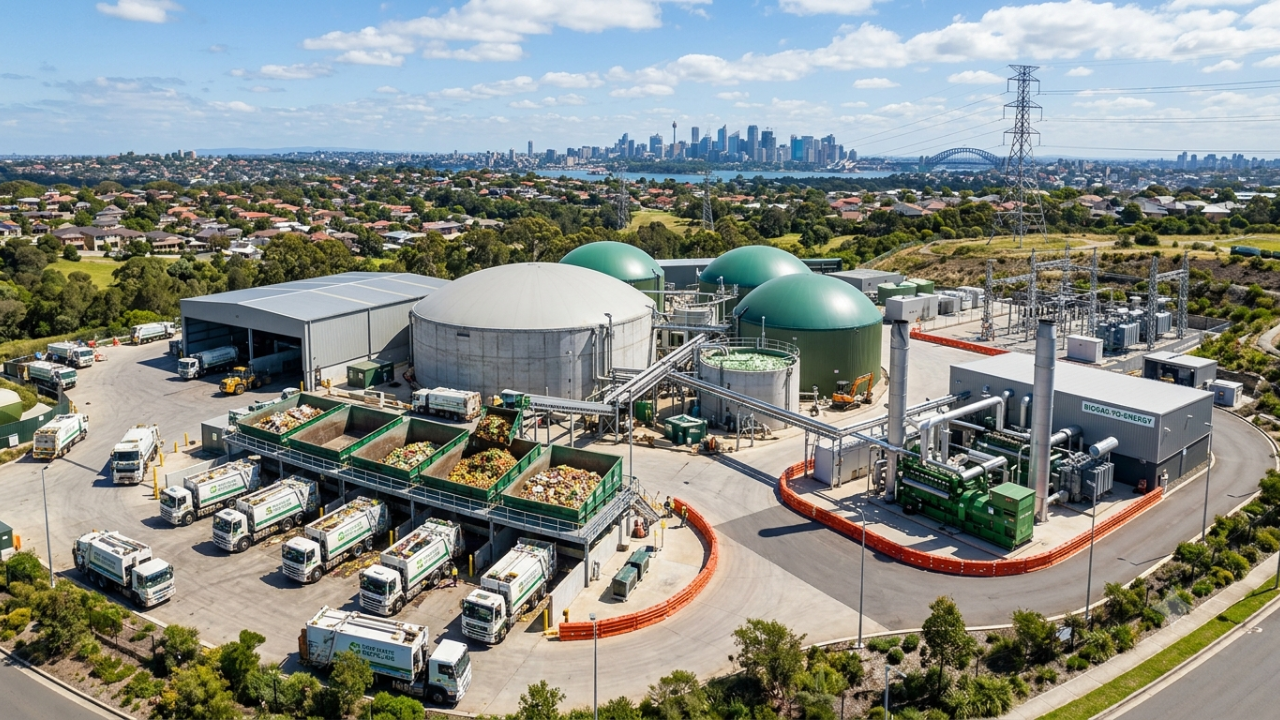
PC: AI Generated
EarthPower’s annual food waste capacity
EarthPower’s capacity changed significantly when the facility underwent major technological upgrades. The improvements increased its annual feedstock capacity to 62,500 tonnes (65% is dedicated to food waste). At that level, the electricity produced can provide enough power for roughly 4,000 homes. The figure is important because the plant is doing more than simply reducing the volume of material requiring disposal. Its output includes an energy product as well as a recovered material that can be used elsewhere. The upgraded capacity also reflects the range of organic waste being handled. Food does not arrive at the site in one consistent form. Some material is solid, some is liquid, and some comes from waste streams such as grease traps or packaged food.
The digestion process creates more than electricity at EarthPower
Anaerobic digestion does not make the entire material disappear. A nutrient-rich sludge remains after the digestion process. At EarthPower, this material is dried using heat generated by the cogeneration engines before being granulated. It can then be sold into agricultural and horticultural markets as a soil improver.That gives the process a second output beyond electricity. The organic waste is effectively split into useful products: the biogas becomes energy, while the remaining material is prepared for use in soil.For a facility dealing with tens of thousands of tonnes of food waste, that distinction matters. The purpose is not simply to move waste somewhere else. The process is designed to recover value from different parts of the material.
EarthPower collects food waste from across Sydney’s supply chain
The feedstock reaching EarthPower comes from several points along the food supply chain. Food manufacturing and processing businesses can send their organic waste to the facility, as can companies involved in transportation, storage, wholesale and retail distribution. Commercial kitchens and local government are also among the sources.This means the system sits alongside the everyday movement of food through Sydney rather than operating as a plant for a single type of discarded material. A supermarket, commercial kitchen or food processor may generate waste for very different reasons, but much of that material shares the same basic characteristic: it contains organic matter that can be broken down. EarthPower’s system is built around making use of that common property.
EarthPower turns biogas into electricity and useful process heat
The most interesting part of the process is perhaps how closely its outputs are linked to its own operation. Biogas produced from the incoming waste fuels the cogeneration engines. Those engines generate electricity, but their heat is also useful. Heat from the engines is used to dry the sludge left behind after digestion. That creates a connected system in which the energy produced during treatment helps prepare another recovered product.The electricity generated on site also helps the facility operate before excess power is sent to the wider grid. In this sense, the plant is not simply an electricity generator attached to a waste facility. The two functions are tied together.
Food waste can be recovered instead of simply sent to landfill
Landfill remains a conventional destination for food waste, but sending organic material through anaerobic digestion changes what can be recovered from it. EarthPower’s process is designed to divert food waste away from landfill while capturing biogas and producing a soil improver. Veolia, which operates the facility, describes the approach as a form of resource recovery in which material that would otherwise be discarded is given another use.For businesses supplying the plant, there is also a practical consideration. Sending food waste for recovery can reduce disposal requirements and associated costs, while the treatment process provides an alternative to fossil-fuel-based energy generation.The result is not a single waste solution but a chain of uses built around the material that remains after food is no longer wanted.
62,500 tonnes of food waste feed EarthPower’s recovery system
After the 2024 upgrades, the EarthPower facility has a total processing capacity of 62,500 tonnes, with Waste Management Review reporting that 65% is dedicated to food waste. The upgraded operation can generate enough green electricity to potentially power around 4,000 local homes.The same process also produces a granulated soil improver for agricultural and horticultural use. So the discarded food arriving at Camellia does not have one final destination. Its organic content is processed into biogas and energy, while the material left after digestion is prepared for another use.For Sydney’s food waste, that turns what begins as a disposal problem into a stream from which both energy and recovered material can be taken.