
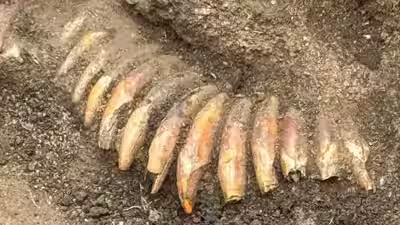
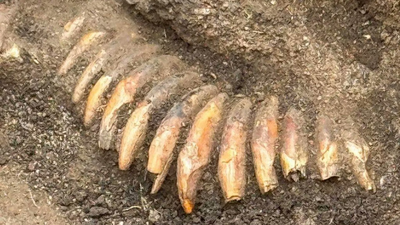
Archaeologists investigating a Roman-period cemetery in Poland made an unexpected discovery when they came across a burial that was thousands of years older than the surrounding graves. Instead of a Roman-era burial, they found the nearly complete skeleton of a Stone Age man who had been buried with an unusual collection of objects, including a battle axe, a flint blade, amber beads and a necklace made from 42 animal teeth. Even more striking, two human skulls were placed in the grave alongside him. The unusual combination of weapons, ornaments and human remains suggests that the man may have held an important position within his community, although archaeologists are still trying to determine exactly why the skulls were buried with him. According to Live Science, the burial was discovered during excavations of a Roman-period cemetery near Wrocław in southwestern Poland. Researchers determined that the grave actually dates to around 2900 B.C., placing it roughly 3,000 years before the Roman cemetery. The adult male was buried with a serpentinite battle axe, amber beads, a flint blade and a distinctive necklace containing 42 drilled mammal teeth. Two human skulls were also found in the grave and may represent decapitated heads deliberately placed there, although further analysis is needed to establish their origin and relationship to the man.
A burial hidden beneath a Roman cemetery
The discovery came as archaeologists were investigating a cemetery associated with the Roman period. The presence of the much older grave shows that the location had been used for burial long before the Romans arrived in the region. The Stone Age grave dates to the Middle Neolithic period, around 2900 B.C. At that time, communities across central Europe were experiencing major cultural changes. The burial’s unusual combination of human remains, weapons and elaborate personal ornaments makes it particularly significant. Researchers believe the man may have belonged to the Corded Ware culture, a widespread prehistoric culture associated with distinctive pottery, burial customs and the movement of people across Europe.
Two human skulls
The most mysterious objects in the grave are the two human skulls. They were found alongside the man’s skeleton rather than attached to his body. This raises the possibility that the skulls were deliberately placed in the grave as part of a funerary or ritual practice. However, archaeologists are being cautious about interpreting them. It is not yet clear whether the people represented by the skulls were killed specifically for the burial, whether their remains were collected after death or whether they had some other relationship with the deceased man.Further examination could reveal whether the skulls belonged to men or women, how old the individuals were and whether their remains show evidence of injury or deliberate decapitation. Researchers also hope to determine whether the individuals were biologically related to the man in the grave.
A necklace made from 42 teeth
Another remarkable feature was the necklace containing 42 mammal teeth. Each tooth had been drilled so it could be attached to a cord or string. The teeth appear to have been deliberately selected and transformed into an ornament rather than simply collected as ordinary animal remains. Such objects could have carried social, symbolic or personal meaning. The discovery also raises the possibility that the man had a special role within his community. According to biological anthropologist Paweł Dąbrowski, as quoted by Live Science, the man may have been a warrior or hunter, while the necklace suggests he could have been an important figure, such as a family clan leader.The exact meaning of the tooth necklace, however, remains uncertain.
A battle axe and other possessions
The man was also buried with a battle axe made from serpentinite, a greenish metamorphic rock. A flint blade and amber beads were found in the grave as well. The axe is particularly significant because weapons placed in prehistoric graves can provide clues about the identity or status of the person being buried. It could indicate that the individual was involved in hunting, combat or another activity associated with authority. Amber, meanwhile, was a valuable material in prehistoric Europe and was traded over considerable distances. Its presence adds to the impression that the burial was not an ordinary one. Together, the axe, blade, amber and tooth necklace form an unusually rich collection of grave goods.
A rare glimpse into Stone Age society
The burial is reportedly only the second example of its kind known from the area, making it especially valuable for understanding prehistoric communities in what is now Poland. The researchers now plan additional analysis of the skeleton and associated remains. Scientists hope to establish more about the man’s age, health, diet and ancestry, while DNA analysis could potentially reveal whether he was related to another individual buried nearby.The discovery also illustrates how archaeologists can find traces of completely different periods layered at the same location. What initially appeared to be part of a Roman cemetery turned out to contain evidence of a much earlier society, separated from the Roman period by thousands of years. For now, the two skulls remain the greatest mystery. Whether they represented enemies, ancestors, relatives or participants in a ritual cannot yet be established. But their presence alongside a weapon, amber ornaments and a necklace made from 42 teeth suggests this Stone Age man was buried in a way that reflected a distinctive social or ritual role, one that archaeologists are only beginning to understand.