
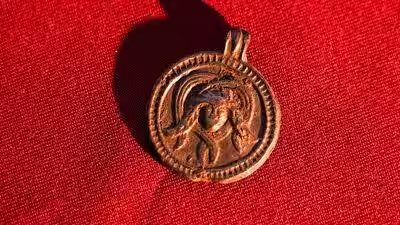
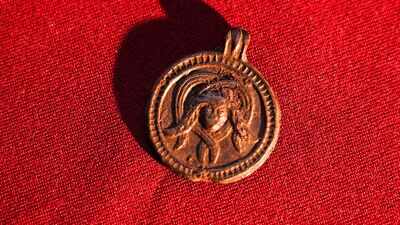
Archaeologists have found an 11th-century pendant in Staraya Russa that combines an image of a Christian saint with a woman’s head featuring snake-like hair. The copper-alloy pendant was uncovered during excavations at the Pyatnitsky site, in an ancient urban household in an area that was being developed in the 11th century. Its two sides carry different images. One features a relief of a warrior saint holding a spear and shield, identified as probably Saint Theodore Stratelates. According to Novgorod State University, the other depicts a woman’s head with snake-like hair, based on the image of Gorgon Medusa.
What does the 11th-century pendant found in Staraya Russa depict
The newly found serpentine dates to the 11th century and is one of the earliest examples known from the medieval Novgorod land. It was found during excavations at the Pyatnitsky site in Staraya Russa, inside an ancient urban household. At the time, the area was still being developed. The pendant is made from a copper-based alloy. One side shows a raised image of a warrior saint holding a spear and shield, probably Theodore Stratelates. The other side shows a woman’s head with snake-like hair. Archaeologists note that this figure was likely a general representation of dark forces rather than a specific creature from ancient mythology.

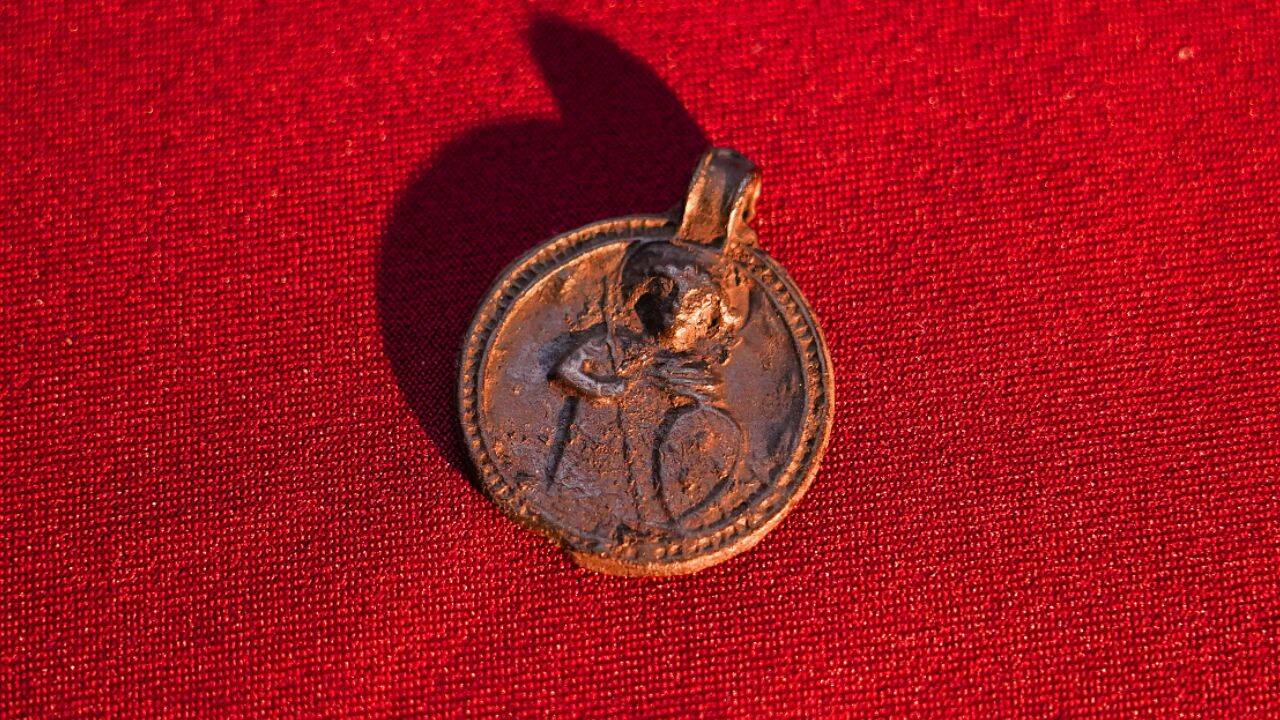
PC: Novgorod State University
Christian and snake-related images shaped Serpentine pendants
Serpentine pendants were two-sided amulets, with a Christian image on one side and a snake-related image on the other. According to NovSU, the Christian side could show Jesus Christ, the Virgin Mary, the Archangel Michael, or saints linked to defeating serpents, including George the Victorious. The other side was based on the image of the Gorgon Medusa from ancient Greek mythology. These inscriptions indicate that the pendants were probably worn as protective amulets against illness. The two different images brought Christian and pagan traditions together.
What the Staraya Russa pendant reveals about Byzantine connections
The Staraya Russa pendant adds to evidence about the community that lived in the settlement during the 11th century and its connections with other regions. Archaeologists note that the non-canonical tradition of wearing serpentine pendants came to Rus from Byzantium. The earliest such pendants found in Ancient Rus date to the 11th century, the same period as the newly discovered pendant. Along with other archaeological finds, the pendant shows that a Christian community was already present in Staraya Russa at that time. NovSU also says the finding points to well-developed cultural ties with Byzantium and the presence of local craft workshops. Before this discovery, only four serpentine pendants had been found in Staraya Russa. All four dated to the late 12th to 14th centuries.
The pendant’s possible owner and place of production
Archaeologists also looked at who may have owned the pendant and where it may have been made. Sergei Toropov, director of the Novgorod State University Center for Archaeological Research, said it may have belonged to a resident of the household who was part of the broad middle social group. According to the university, poorer people could not afford such an item, while members of the elite wore jewellery made from expensive silver and gold. Researchers also indicate that the pendant may have been made using another similar object as a model. A workshop that could produce such an item may have operated in the same household where the pendant was found.