
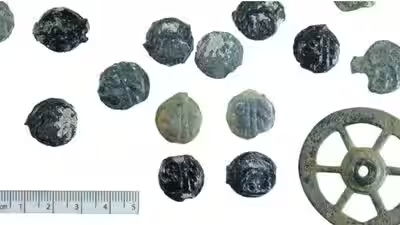
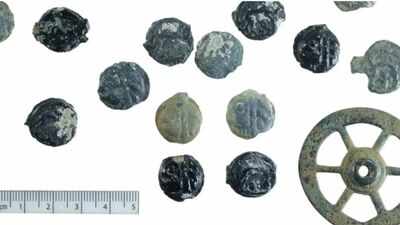
Archaeologists working in northeastern France have uncovered 28 ancient Gallic coins in a small pit beside fragments of a human skull and a miniature bronze wagon wheel, a combination that suggests the site may have been a Late Iron Age sanctuary. The finds were made during preventive excavations near Bure in the Meuse department, an area being investigated in connection with France’s Cigéo deep geological repository project, as per reports by Inkorr and The History Blog.The discovery is significant because the objects appear to have been deliberately deposited rather than casually lost. The coins, known as potins, were found alongside human bone fragments and a five-centimetre metal wheel, a type of miniature object often associated with votive offerings in Iron Age Gaul. Researchers believe the site may have served a ritual purpose for the Leuci, a Gallic people who lived in the region during the Late La Tène period. Read more about it, as per the reports, here:
What was found
The excavation revealed a building measuring about 7.5 by 5.5 metres. Archaeologists identified four large postholes, each roughly one metre in diameter and more than 80 centimetres deep. The arrangement suggests that the posts may have leaned inward, possibly forming a conical structure rather than a conventional rectangular building.Inside one of the postholes, researchers recovered fragments of a human skull and lower jaw. The presence of human remains in an Iron Age sanctuary is not necessarily evidence of a burial in the modern sense. In ancient Gaul, skulls and other human remains could be treated as sacred deposits, particularly in ritual or ceremonial settings.The 28 cast Gallic coins were found in a small pit near the remains. These potins circulated in northeastern Gaul during the Late Iron Age and typically carried stylized imagery rather than realistic portraits. Their presence with skull fragments and a miniature wheel makes the assemblage especially unusual for the territory of the Leuci.
The coins and the wheel
The coins depict a stylized human head influenced by portraits of Philip II of Macedon, along with a military standard shaped like a boar and a symbol resembling either a fleur-de-lis or an inverted letter T. Such imagery reflects the cultural connections and artistic influences circulating across Gaul in the centuries before Roman conquest.The miniature wheel is only about five centimetres wide. Archaeologists believe objects of this kind may have served as amulets or ritual offerings. At first glance, a wagon wheel doesn’t seem like an obvious religious symbol, but wheels were important in Iron Age societies both practically and symbolically. Vehicles, movement and the cycles of life could all have potent associations.The coins, wheel and human remains together form a pattern that is consistent with known votive practices. Many Iron Age sanctuaries contain pits, postholes or other defined spaces into which people deposited valuable or meaningful objects. The act of burial itself may have been part of the ritual, rather than simply a way of storing items.
Why a sanctuary is likely
The building’s unusual shape, the deliberate placement of objects, and the presence of human remains all support the idea that the site was more than an ordinary settlement structure. The large postholes suggest a substantial construction, while the small pit containing the coins and bone fragments points to a focused ritual deposit.Archaeologists cannot yet say exactly what ceremonies took place there or which deity, if any, was honoured. The evidence does, however, fit the broader pattern of Late Iron Age religious activity in Gaul, where sanctuaries often combined architecture, offerings, and symbolic deposits. The discovery is described as exceptionally rare for this part of the Leuci territory and unusual in Belgic Gaul more broadly.The term “sanctuary” does not necessarily mean a temple in the classical Roman sense. It can refer to a sacred space used for offerings, ceremonies, or communal rituals. The building may have housed such activities, while the deposits preserved in its postholes may represent offerings made at particular moments in the site’s use.
A window into the Leuci
The Leuci were one of the Gallic peoples inhabiting parts of northeastern Gaul before Roman expansion reshaped the region. Finds like these help researchers understand not only what they made and used, but also how they organised belief, memory, and community life. Coins, for example, can reveal trade links, political imagery, and the movement of ideas across tribal boundaries.The skull fragments add an even creepier element. Human remains found in ritual context could reveal ancestor veneration, commemoration, trophy practices, or other customs that are hard to interpret from archeology alone. The bones will need further analysis by scientists to establish their age, sex, condition and whether they show any signs of trauma or deliberate treatment.The little wheel might be especially telling. If it was made specifically as an offering, rather than broken from a full-size vehicle, it strengthens the case that the deposit was ritual in nature. Its tiny size and careful positioning beside the coins and skull fragments suggests it was deliberately placed, and not accidentally lost.
Why the site matters
The discovery adds to a growing picture of religious and cultural life in Late Iron Age Gaul. It also shows how modern infrastructure projects can uncover evidence that would otherwise remain hidden beneath farmland, roads, and development sites. The excavation was carried out by France’s National Institute for Preventive Archaeological Research, known as Inrap, as part of work linked to the Cigéo project.The area around Bure has already produced important archaeological finds, including burials with horses, gold and silver jewellery, and weapons dating to around 1,500 years ago. Some skeletons show potentially fatal weapon injuries, offering evidence of conflict during the decline of the Roman Empire. The new sanctuary discovery adds an earlier layer to that story, reaching back to the centuries before Roman rule.For now, the site remains under study. Further study of the coins, bones, soil and building remains could help archeologists develop a clearer chronology, and also learn if the structure was a sanctuary, a ritual enclosure or something more complex. What is already clear is that the small pit beside a human skull held more than loose change. It held a rare window into the beliefs and practices of ancient Gaul.