
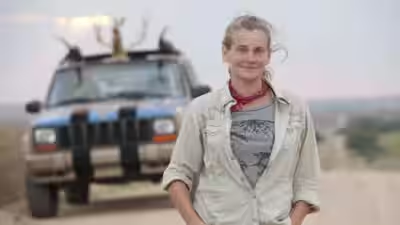

For more than two decades, American artist Erika Nelson has travelled across the United States documenting some of its most unusual roadside attractions, from oversized sculptures to landmarks built to catch the attention of passing motorists. But instead of simply photographing these giant creations, Nelson recreates them as tiny handmade models, preserving the details and distinctive character of the original structures. Her growing collection, titled The World’s Largest Collection of the World’s Smallest Versions of the World’s Largest Things, has earned recognition from Guinness World Records. Nearly 200 miniatures are now part of the collection, which has a permanent home at a dedicated exhibition space in Lucas, Kansas.
How an artist began chasing America’s biggest roadside attractions
Nelson’s fascination with oversized roadside landmarks dates back to her childhood. Growing up in Missouri, she remembers using a water tower painted to resemble a giant eight-ball as a local landmark. Visits to her grandparents in Minnesota also brought her face to face with the enormous Paul Bunyan statue, another attraction that stayed with her.The idea for her miniature collection took shape while she was studying art. During road trips, she began visiting unusual roadside structures, recording their stories and looking for souvenirs that captured what made each attraction special. When she could not find suitable keepsakes, she decided to make her own. She began with small replicas of the landmarks she encountered, gradually turning the idea into a long-running project.
From a travelling museum to a permanent home
Nelson spent two years living in a vehicle while exploring the United States, visiting roadside attractions and collecting stories about the people and communities behind them. As her collection grew, she converted a small bus into a mobile exhibition, taking the miniatures to art events, cultural centres, colleges and festivals.The travelling display eventually found a permanent home in downtown Lucas, Kansas. Nelson established the Roadside Sideshow Expo in 2017, turning an old storefront into a museum dedicated to her miniature interpretations of America’s oversized landmarks. The exhibition brings together models from across the country, allowing visitors to explore the attractions without having to travel hundreds of miles between them.

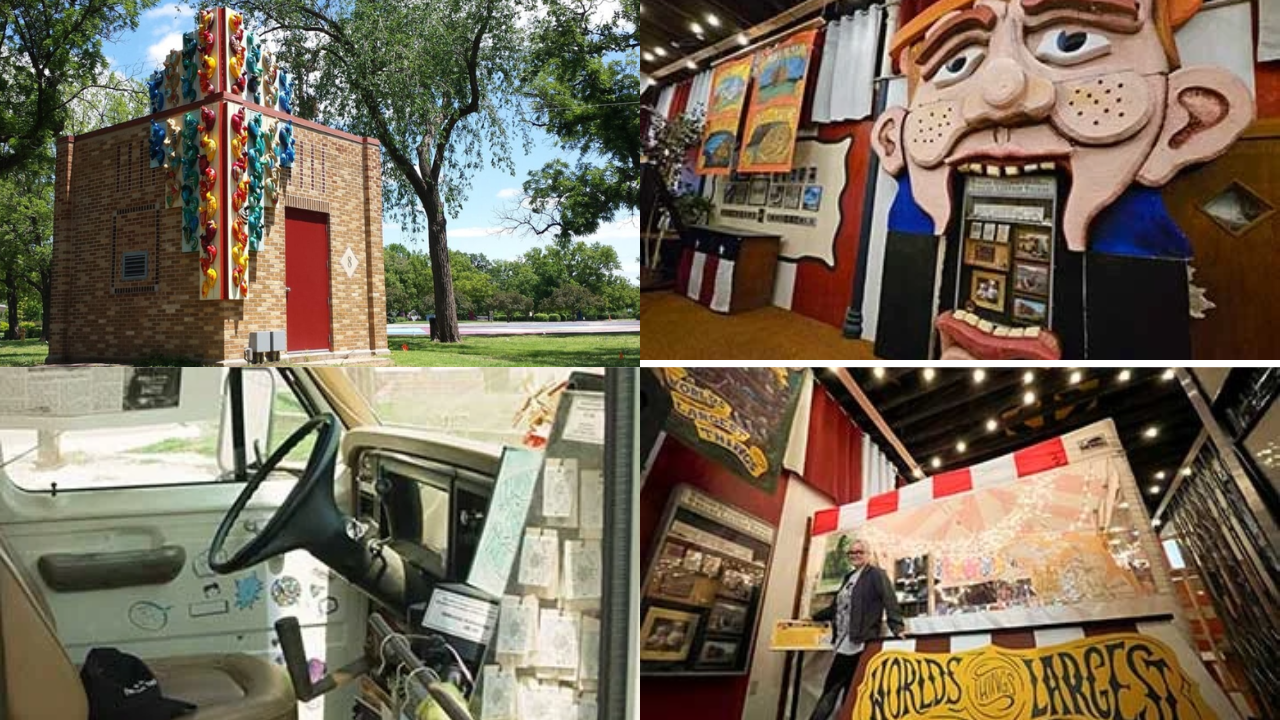
How she recreates giant landmarks in miniature
The models are handmade, and Nelson selects materials according to the object she is recreating. For many attractions originally built from fibreglass or concrete, she uses two-part polymer clay or sculpting medium, followed by paint and other finishing details. She also adapts everyday objects when they can help reproduce a landmark’s shape.Some of her material choices are particularly unusual. To recreate the world’s largest ball of rubber bands, she used the tiny rubber bands commonly used by orthodontists. For a miniature version of the world’s largest cow hairball, she used cat hair. Her replica of the giant baseball bat outside the Louisville Slugger Museum in Kentucky was made using a modified ornament and a model railway building adapted to resemble the museum.
The stories behind the giant roadside attractions
For Nelson, these structures are more than oversized objects designed to attract attention. Many are expressions of local identity, created by residents, businesses or communities hoping to give travellers a reason to stop and explore their towns. Their subjects range from familiar objects to unusual local symbols, with each attraction carrying a story about the place where it stands.One example that caught Nelson’s attention was a giant concrete penny weighing around 17,000 pounds. Its story reflects the community spirit behind some of America’s roadside creations. Other attractions represented in her collection include Otto the Otter, a giant baseball bat and an oversized rendering of Van Gogh’s Three Sunflowers in a Vase in Goodland, Kansas.
Nearly 200 miniatures earn Guinness World Records recognition
The collection has received a Guinness World Records title for the largest collection of miniature replicas of the world’s largest things. According to Guinness, the museum in Lucas contained around 200 handmade replicas as of 2025. Nelson’s models are generally less than two inches in their largest dimension, making the contrast with the original attractions particularly striking.The collection continues to evolve as Nelson discovers more roadside landmarks and adds new pieces. The miniatures are intended as one-of-a-kind works rather than mass-produced souvenirs, and they are not generally offered for sale. Some have also been damaged by sunlight, temperature changes or visitors, while others have had to be retired after the original attractions were dismantled. The exhibition even has a display dedicated to models that have met unusual ends, preserving the stories of the miniatures that could not survive the journey.