
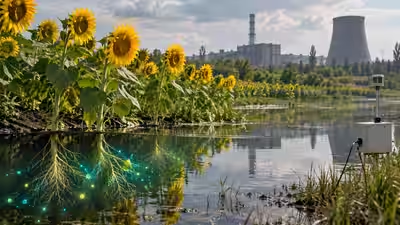
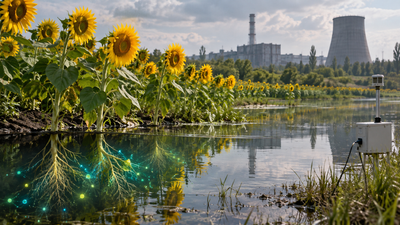
After the 1986 Chernobyl nuclear disaster, scientists explored an unusual way of dealing with radioactive contamination by using plants to absorb radionuclides from the environment. Sunflowers emerged as a promising candidate because their roots can take up certain radioactive elements, including cesium and strontium, from contaminated water. Experiments near Chernobyl showed that sunflowers could remove substantial amounts of radionuclides from a small contaminated pond. The approach was later investigated after the 2011 Fukushima Daiichi nuclear accident as well. Researchers found that the flowers could take up radioactive material, although their effectiveness varied greatly depending on whether the contamination was in water or soil.
How sunflowers absorb radioactive material after Chernobyl nuclear disaster
The process is known as phytoremediation, where plants are used to remove or contain pollutants. A related technique called rhizofiltration uses plant roots to capture contaminants from water. Sunflowers attracted attention because they grow rapidly, produce substantial biomass and absorb elements through their normal nutrient-uptake processes. Radioactive cesium-137 has chemical similarities to potassium, an essential plant nutrient, while strontium-90 behaves in some ways like calcium. These similarities allow plants to take up radioactive forms of the elements through pathways used for nutrients, making sunflowers a useful candidate for experiments involving contaminated water and soil.
Chernobyl’s contaminated pond experiment
One of the best-known demonstrations was carried out in the Chernobyl area using a small contaminated pond. Rather than simply planting sunflowers in the surrounding soil, researchers grew them on floating rafts placed in the water, allowing their roots to extend into the contaminated pond. A US Environmental Protection Agency technology assessment reported that sunflowers used in the Chernobyl demonstration extracted about 95% of the radionuclides from the pond within 10 days. The experiment involved rhizofiltration and focused on radioactive cesium and strontium. The result demonstrated that plants could capture significant quantities of radioactive material when the contaminants were accessible in water.

Why cesium and strontium entered the plants
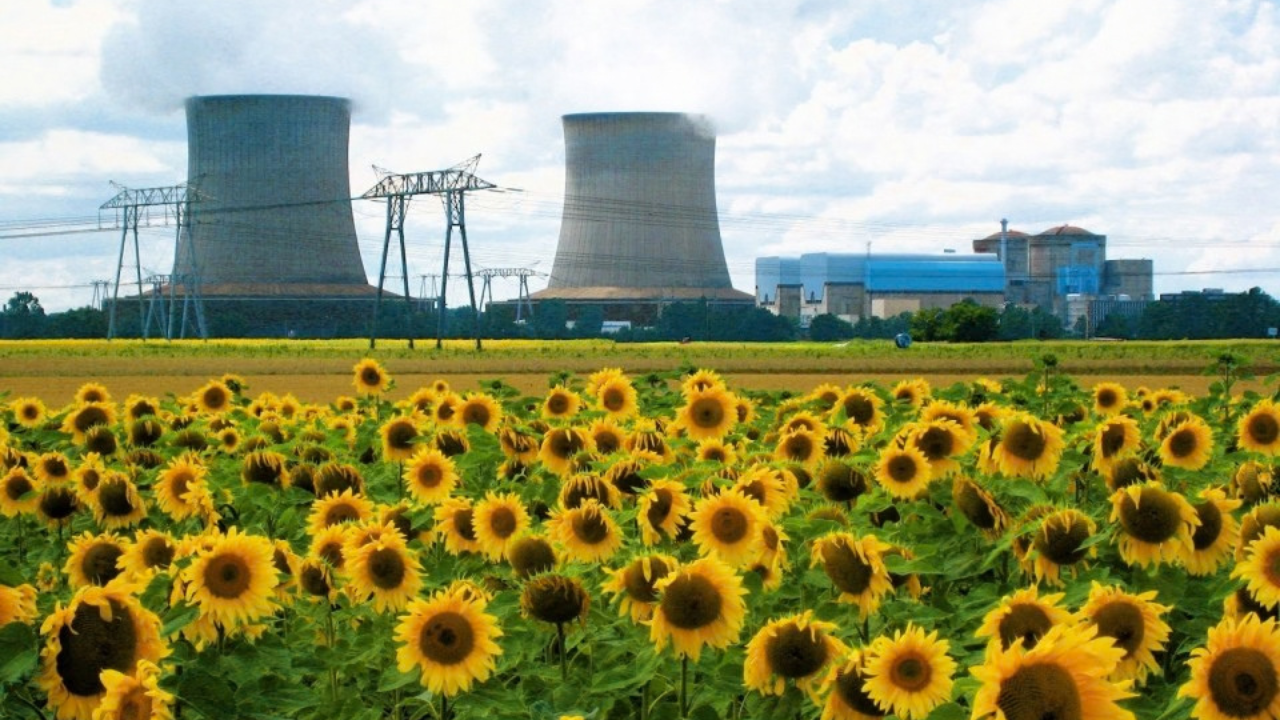
The uptake of radioactive isotopes by plants is closely connected to their chemistry. Cesium-137 has similarities to potassium, which plants need for normal growth, meaning radioactive cesium can enter through some of the same biological pathways used to absorb potassium. Strontium-90 is chemically similar to calcium, allowing plants to absorb it through processes associated with calcium uptake. Once absorbed, the radionuclides can move through the plant and accumulate in different tissues, including roots, stems and leaves. The amount and location of accumulation depend on the isotope, plant species and growing conditions. The process transfers radioactive material into the plant rather than destroying the radioactivity itself.
Why contaminated soil was much harder
The impressive results from contaminated water did not automatically translate to radioactive soil. Cesium can become strongly attached to soil particles, particularly clay minerals, making it much less mobile and less available to plant roots. Japan’s Ministry of the Environment explains that minerals including vermiculite and illite can strongly fix radioactive cesium in soil, reducing the amount that can dissolve into soil water and subsequently enter plants. This became particularly important after Fukushima, where radiocesium contaminated large areas of agricultural land. The amount of cesium present in soil therefore did not necessarily correspond to the amount that a sunflower could absorb.
Sunflowers were tested after Fukushima
The sunflower approach was also investigated following the 2011 Fukushima Daiichi nuclear accident. Japanese researchers tested several plants to determine whether they could absorb radiocesium from contaminated agricultural soil, with sunflowers among the species examined. A Japanese government report describes a demonstration in Iitate Village, where sunflowers and other plants were grown in soil containing approximately 7,715 becquerels of radiocesium per kilogram. Researchers measured the amount of radiocesium taken up by the plants and examined the resulting plant material. The trials formed part of wider research into whether phytoremediation could provide an alternative method for dealing with contaminated farmland.
What Fukushima revealed about the method
The Fukushima experiments showed that a plant’s ability to absorb cesium does not necessarily mean it can remove enough cesium from soil to make large-scale decontamination practical. The problem was largely connected to the way cesium interacted with the soil. After radioactive cesium reaches clay-rich soil, it can become strongly fixed to mineral surfaces, remaining concentrated near the surface while becoming increasingly unavailable to plant roots. Scientific studies of Fukushima soils have found that weathered mica and other minerals can strongly bind Cs-137, reducing its transfer from soil into vegetation. Consequently, sunflower cultivation alone could not extract enough radioactive cesium from contaminated agricultural soil to serve as a comprehensive decontamination method.
The radioactive plants had to be handled
When sunflowers absorb radionuclides, the radioactive material becomes concentrated in their tissues, meaning harvesting the plants does not eliminate the radioactivity. Instead, it transfers part of the contamination into plant biomass that must be collected and appropriately managed. This is a central part of phytoremediation: the plant acts as a biological collector, taking contaminants out of water or soil and concentrating them in a smaller quantity of material. In the Chernobyl water experiments, this made it possible to repeatedly use plants to capture radionuclides from contaminated water before removing the resulting biomass from the environment.
Why water produced better results than soil
The difference between the two environments comes down largely to the availability of the radioactive material. Radionuclides dissolved or suspended in water can come into direct contact with plant roots, allowing the roots to absorb them more readily. Soil is more complicated because contaminants can become attached to mineral particles, trapped within soil structures or otherwise become unavailable to plants. This helps explain why the Chernobyl pond experiment produced striking results while attempts to remove radioactive cesium from soil were considerably more difficult. The effectiveness of phytoremediation therefore depends not only on the plant but also on the chemical and physical conditions surrounding its roots.
From Chernobyl to Fukushima
The experiments following the two nuclear disasters helped scientists better understand the potential and limitations of plant-based radioactive cleanup. At Chernobyl, sunflowers demonstrated that plant roots could capture radionuclides from contaminated water, while at Fukushima researchers tested whether the same biological mechanism could help remove radioactive cesium from agricultural soil. The results showed that the surrounding chemistry was as important as the plant itself. Sunflowers could absorb radioactive isotopes, but the amount they could remove depended on how easily those isotopes could move from the environment into the roots. Their ability to capture cesium and strontium consequently made them a useful subject for phytoremediation research, even though the approach could not by itself provide a large-scale solution for contaminated soil.