
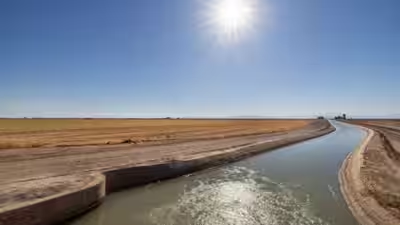
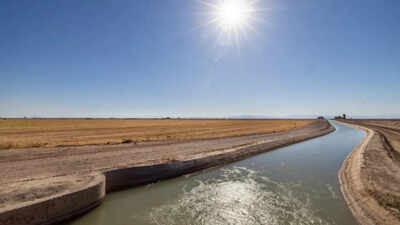
The AI boom is spreading data centres across the world faster than most tech projects. These AI lifelines work on two important resources, water and electricity, which they use from the areas they are located in. Often this leads to a fight between the locals and the tech giant owning the data centre since resources are limited and want is not.Case in point is an AI data centre being built in Southern California’s Imperial Valley. Deemed as the largest AI data centre in the state, the 330-megawatt unit earlier promised to not use water from Colorado River. But now, the developer behind the project is suing for access to the river water which is already a threatened source of freshwater for 40 million people and the centre of countless disputes over water use in West.
CJP Jantar Mantar Protest Updates
The Colorado River is the only source of freshwater in the Imperial Valley, which has long faced drought and water supply issues. It is also the largest user of the water in the seven states that rely on the river. Farmers use about 80% of the state’s full allocation.The lawsuit, filed in June 2026 by Imperial Valley Computer Manufacturing, says the company needs access to 287 million gallons of water for the data centre. It was filed after two cities, El Centro and Imperial, snubbed the bid to get recycled wastewater to cool the proposed data center. The Imperial Irrigation District, a local agency that delivers Colorado River water in the Imperial Valley, denied the company’s request for water for the project. It is also accompanied by a push back from communities across US against data centres. People in the Imperial Valley have called out data centers. At a meeting in late March covered by California’s KPBS News, the crowd became unruly as Rucci spoke, and the board went into a recess.The developer, Sebastian Rucci, a Huntington Beach lawyer and businessman pushing the plan, said the project would not add to the demand on the river overall because the company would fallow, or stop irrigating, nearby farmland and use that water to cool the data centre instead. He said the proposal would have “zero impact” because the data center would not require any additional allocation from the Colorado River, adding that its water demand would be similar to that of a 160-acre farm. However, the developer went back on a statement that he had no intention of using water from the over-allocated Colorado River.For water experts and local advocates, the case raises a bigger question than how much water a single data centre should use. As water becomes scarcer and new industries increase demand, should water historically used for farming be redirected to power the AI boom?
From farming to data centres?
Imperial Valley has been known for farming with cattle, alfalfa lettuce and spinach among its top commodities. John Fleck, a writer and water policy expert at the University of New Mexico, told Business Insider that “taking land out of agricultural production to use for other things is a values question, even if it’s a small amount.”Michael Cohen, a senior fellow at the Pacific Institute focusing on Colorado River Basin water use, said the issue is not necessarily the amount of water, but rather the developer’s plan to access farmland, dry it up, and reallocate it for industrial use.Imperial Valley’s economy has long relied on Colorado River agriculture. If it weren’t for that part of the country around Imperial and Yuma, Arizona, “no one in America could afford a salad in February,” Rhett Larson, a water-law expert at Arizona State University, said. He added that while farmers may make money selling land or water rights, the people who are often hurt are the fertilizer salesmen, tractor repairmen, teachers, dry cleaners, or anyone in these rural communities who doesn’t have land or water rights to sell.
A bright future?
Rucci said his company has a contract to purchase the land and water assignments from farmers. He also said he pursued this strategy after his proposals to use reclaimed water were rejected. He added that the data centre would bring major economic benefits to Imperial County, including 1,688 construction jobs, over a hundred permanent jobs, and an estimated $2.95 billion in economic improvement over 30 years, citing an independent economic study prepared for the county. While individual landowners may profit from the practice, taking farmland out of production can have cascading effects in agricultural communities, including fewer farm-related jobs.“Economic diversification is exactly what the area needs,” Rucci said in an emailed statement to the outlet, pointing to Imperial County’s high unemployment. The county’s unemployment rate was about 17% as of May, according to state data.Eric Reyes, an Imperial Valley resident and executive director at the advocacy organization Los Amigos de la Comunidad, said he’s concerned the lawsuit is an attempt to circumvent the Imperial Irrigation District (IDD), a publicly owned utility governed by an elected board that has long held the water rights in the area, rather than individual landowners. He said the developer’s plan “raised a huge red flag” because it could involve a “private deal with a landowner and then use it for his own purpose.“However, Rucci rejected the idea that the company is trying to circumvent IID’s control and said farmers have the right under state law to assign water, and that the proposals would not require “a single additional drop” from the Colorado River.“The Colorado River basin has to decide what we want to be when we grow up and what it will take to get there,” said Larson. “We have enough water to do a lot of great things. But we don’t have enough water to do every good thing.”