
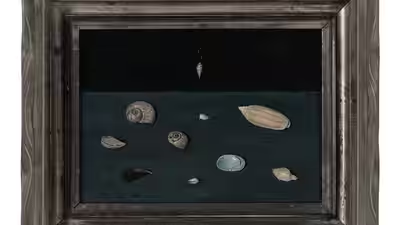
Everyone peeks at an estate sale. He did too. He thought he would get his hands on some records or perhaps some mid-century furniture. That’s when he saw a painting hanging in the dark corner of a hallway. For most people, it may not necessarily have been an extraordinary painting. All there was on the 8-by-11-inch canvas were some seashells. Most buyers’ eyes would slide past such works, but this man’s didn’t. He spotted a signature on it that read: Abercrombie. He knew it was valuable. The painting was up for sale for $30. He didn’t think twice. He bought it.A few months later, five phone bidders and several online bidders competed for the painting at Freeman’s in New York. The auction house had estimated it would sell for $150,000 to $250,000. And on October 1, the hammer fell at $1,060,000! Along with the buyer’s premium, it came to $1,352,600. Imagine making a fortune out of $30! Well, this work was especially prized. No work by Gertrude Abercrombie had ever gone above $1 million. This one was quite rare! And only the right person saw its value.
The Milwaukee exhibition that changed everything

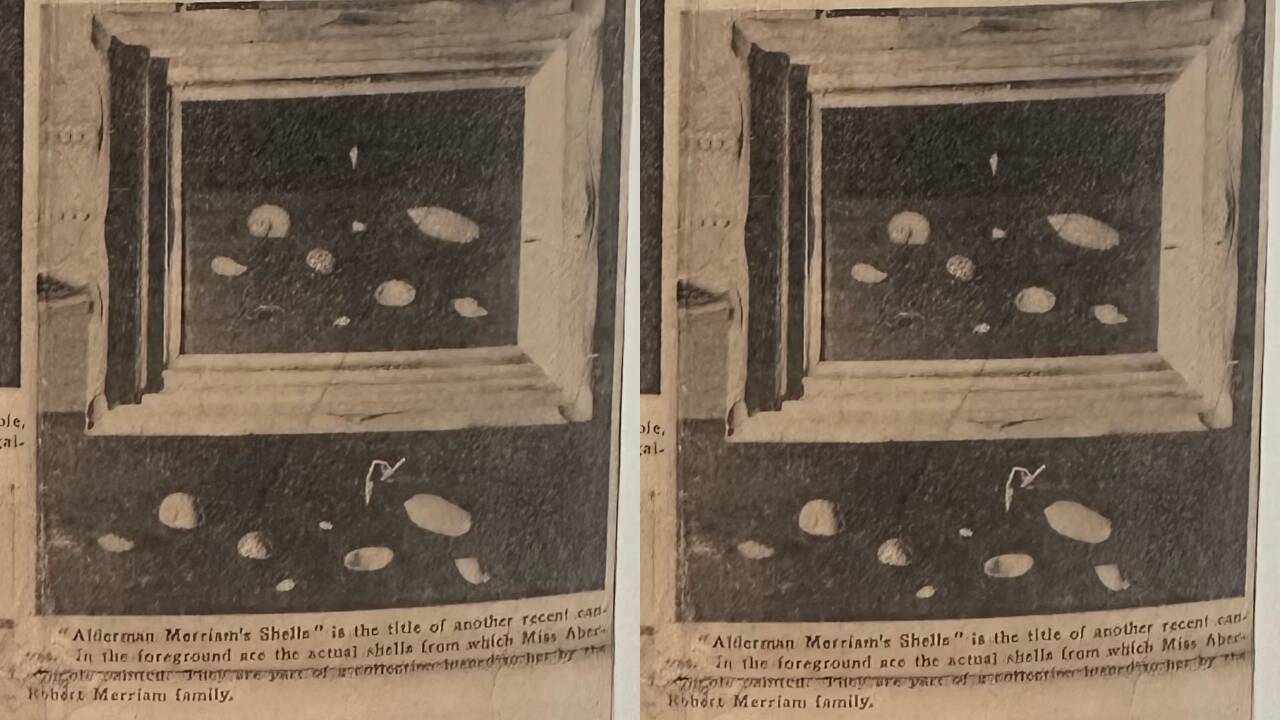
The buyer, who chose to stay anonymous, saw the signature on the painting while purchasing it at the estate sale in Kalamazoo, Michigan. But, as a longtime collector, he already knew it was not proof. He changed his family holiday plans to visit the Gertrude Abercrombie exhibition The Whole World Is a Mystery at the Milwaukee Art Museum. In the exhibition catalogue, he found a 1952 Chicago Tribune photograph of the painting in its original frame, displayed alongside the actual shells Abercrombie had painted. The photograph gave him an idea of what he had. Dr Susan Weininger, the leading Abercrombie scholar and a professor emerita of art history at Roosevelt University, also looked at it. She authenticated it. It was real. Things progressed soon. The buyer gave it to Freeman’s to sell, knowing the auction house had sponsored the Milwaukee exhibition.
A rare painting from 1951
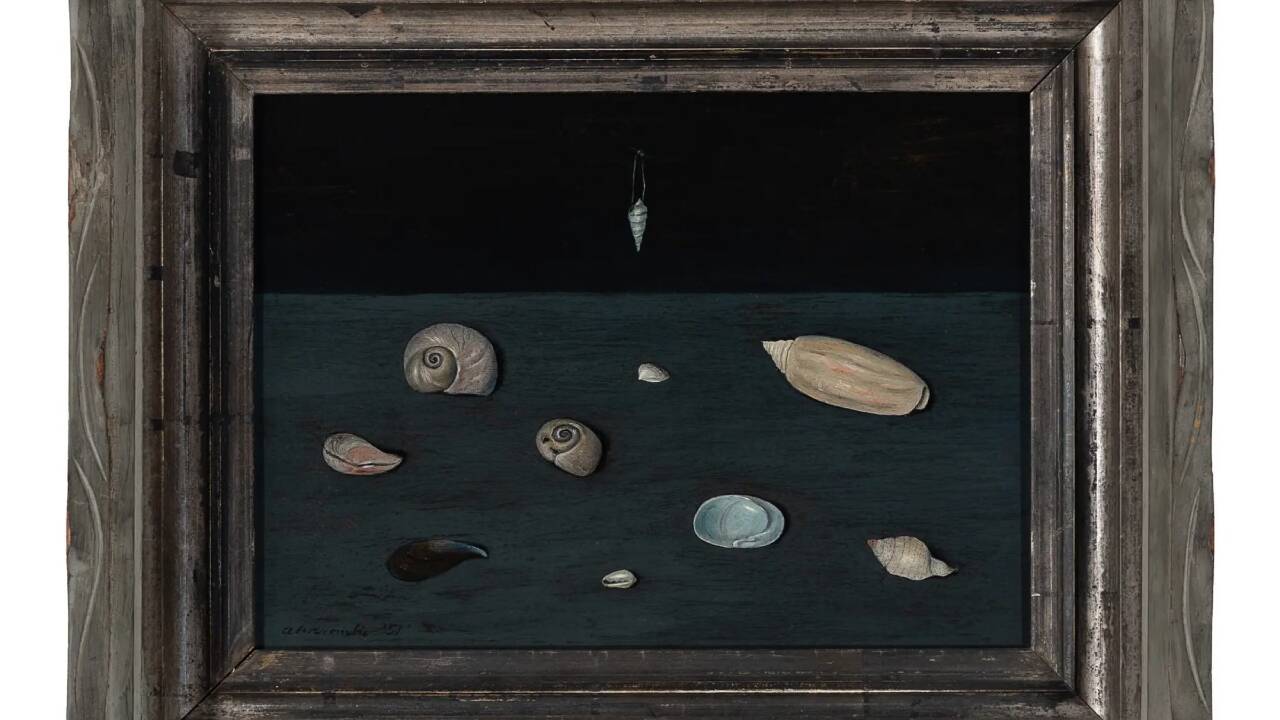
Alderman Merriam’s Shells, 1951
Painted by Gertrude Abercrombie, a Chicago Surrealist artist, the painting Alderman Merriam’s Shells had been missing from public view for 75 years. The work depicts nine finely rendered seashells on a slate-grey surface, with a single conical shell suspended by a thread against a black wall, appearing to levitate above the rest. The shells were real, and so was their owner. Robert Merriam was alderman of Hyde Park, the Chicago neighbourhood where Abercrombie lived and worked. Hence the title.“A rare instance of the artist painting directly from life, it confirms that the shell motif in her later solitary shell paintings, long presumed invented, was drawn from observation and memory,” the auction house said in a release.The painting was exhibited in six solo shows in 1952 and 1953. Abercrombie gave it to Dr John Reynolds of Kalamazoo, Michigan, in exchange for medical services. The photograph stayed with his family until its rediscovery this year.“No fairytale would be complete without a storybook ending, and Gertrude Abercrombie’s Alderman Merriam’s Shells selling for a new auction record is as happily ever after as it gets. As happy as we are to have recaptured the record sale price for an artist we have long championed, we are even happier for our eagle-eyed consignor who saved this masterpiece from staying forever lost to time. I love it when good things happen to good people and when the story unfolds in reality just as we wrote it. The Abercrombie shooting the moon was obviously the high point of the day, but the rest of the sale shone bright, with great results across the board to add to the magic of the day,” said Zack Wirsum, Senior Vice President, Head of Department, Post War & Contemporary Art, speaking about the sale.And just like that, a painting found at an estate sale for $30 made over a million dollars.