
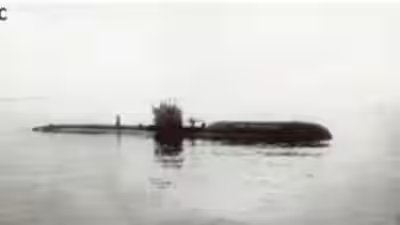
A German submarine that sank off Denmark’s Rømø island in 1917 is leaking TNT into the North Sea, according to a finding announced by Aarhus University on August 27, 2026. Researchers found the chemical in seawater, sediment and even animals at the site. Blue mussels left for at least 11 weeks at the hull of the submarine that lies about 6 miles off the Danish coast, had absorbed it too. A 2024 report for Denmark’s Environmental Protection Agency estimates the wreck of UC-30 still holds about 2,000 kg of the explosive.Katrine Juul Andresen, a geoscience professor at Aarhus University, examined UC-30 through the European NorthSeaWrecks project. Civilian diving is banned at the wreck, and naval charts mark a restricted zone 328 feet (100 meters) around it. Danish navy divers therefore collected the samples after she briefed them.Along with water and sediment, the divers brought up starfish and mussels living on the submarine as samples. Romina Marietta Schuster of Germany’s Alfred Wegener Institute led the mussel study, with Andresen among the coauthors. Her team fixed cages of blue mussels to three wrecks. Besides UC-30, they used the KW58 Hendericus in Belgian waters and the cruiser SMS Mainz in German waters.TNT or its breakdown products turned up in 56 of the 59 mussels from UC-30. The count was 51 of 60 at KW58, and the animals from SMS Mainz contained none. UC-30 was also the only site with explosive compounds detectable in the water. TNT there reached 72.6 nanograms per liter, and a nanogram is one-billionth of a gram.“We found traces of TNT in the wildlife, the seabed, and the water column,” Andresen said in the university’s Danish-language statement. Inside the animals, the team measured more lipofuscin, a waste pigment that builds up in stressed cells. Stored glycogen fell and detoxification enzymes weakened. “The results also correspond with the amount of TNT pollution detected on the wrecks,” the authors wrote.For now she expects the damage to stay fairly close to the hull. “It is likely a relatively localized source of pollution, but it will worsen as the wreck continues to deteriorate,” she said.According to the paper, the mines on UC-30 sit in direct contact with seawater and have corroded heavily. Andresen’s report for the Danish agency called it a high-risk wreck where leakage is under way. Releases like this add to the man-made chemicals already measured in seawater worldwide.In March 1917, Germany sent UC-30 toward Ireland to lay mines. The submarine measured 168 feet (51 meters), and engine trouble soon forced its crew to turn back. It had nearly reached home on April 19 when it struck a British mine, killing 27 men. Aarhus University said the boat carried 18 mines and six torpedoes that day. The new paper estimates the explosives on board at 6,900 to 10,600 pounds (3,120 to 4,812 kilograms). Danish diver Gert Normann Andersen located the wreck in 2016, almost a century later.The findings are part of a broader investigation into the environmental legacy of the two world wars. According to the European REMARCO project, thousands of wrecks containing explosives and other hazardous materials remain on the seabed. As their metal hulls and ammunition casings corrode in saltwater, chemicals can escape and enter the surrounding marine ecosystem.The mussel experiment was conducted at three wreck sites during research campaigns between 2020 and 2022. Researchers used the animals as biological indicators because they filter water and can accumulate contaminants from their surroundings. The differences between the sites were significant: mussels at UC-30 and KW58 showed traces of TNT or its breakdown products, while those placed at SMS Mainz did not. The team also observed changes in biological markers associated with cellular stress and the animals’ ability to process harmful substances.However, the researchers have not established how far the contamination from UC-30 has travelled. The study focused on organisms placed at the wrecks and did not examine seafood sold for human consumption. It also found no mussel deaths during the experiment, meaning the results point to measurable biological stress rather than a mass die-off.The scale of the challenge extends beyond this submarine. A 2024 assessment commissioned by Denmark’s Environmental Protection Agency recorded 10,127 wrecks in the country’s waters. Around 15% dated from periods covering the First and Second World Wars, although not all of them necessarily contain ammunition. Researchers say wrecks buried under sand pose a lower pollution risk because their contents are less exposed to seawater.Removing the explosives is not straightforward either. Detonating old ammunition underwater can release additional contaminants, and the impact depends on currents and seabed conditions. In some cases, specialists retrieve the explosives and neutralise them on land, but the process is expensive. European researchers are also testing underwater robots equipped with sensors to locate dangerous ammunition and collect samples. The aim is to identify the most hazardous wrecks first and find ways to address them without worsening the pollution.