
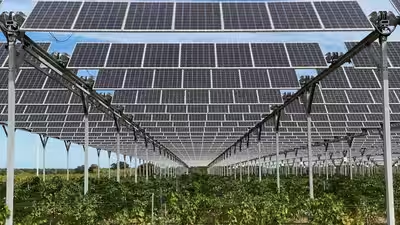
A cognac grower in western France has voluntarily given up the right to call his wine cognac, all so he could build a solar canopy over his vineyard. David Moreau planted four hectares of ugni blanc grapes at Saint-André-de-Lidon, near Saintes, and covered them with 6,000 solar panels held five metres above the vines. The panels tilt through the day to balance shade and sunlight, and lie completely flat when hail strikes, forming a hard shield over the fruit. The project cost around four million euros to build, yet Moreau earns just 600 euros a year in electricity rent from it. He will not know if the gamble paid off until his first harvest under the system in 2029.
Why a cognac grower gave up his wine label for solar panels
French wine rules are strict about what happens above a vineyard as much as what happens in the soil. A regulation dating back to 2002 bans any roof or covering over vineyards that carry an AOC or IGP designation, the geographical labels that apply to roughly 95 per cent of everything France bottles. Moreau’s solar array falls foul of that rule, so whatever wine comes off his four hectares will be sold without the cognac designation. He accepted that trade because his real enemy is a heat problem called echaudage, the scorching of grapes on the vine during a summer spike, which costs him 5 to 10 per cent of his harvest most years.
How the solar canopy protects vines from hail and frost
The hardware was built by Sun’Agri, the agrivoltaic arm of the French construction group Eiffage, and it runs on software that reads plant growth models and on-site weather sensors to decide how the panels should tilt. When hail approaches, the array folds flat, and Moreau has told the French news agency AFP that this saves 70 to 80 per cent of his vines during a storm. The same flat position also traps a layer of warm air near the ground on cold nights, cutting frost risk by around 90 per cent according to the grower. Sun’Agri’s published findings on vine growing describe a roughly 2-degree Celsius buffer during near-freezing conditions and up to 5-degree cooling under the panels during heat spikes, numbers that come from the company running the technology rather than an outside audit.
What the data from other Sun’Agri vineyards shows
Moreau is not the first to try this. At Domaine de Nidolères in the Pyrénées Orientales, growers have run a Sun’Agri array since 2018 alongside an uncovered control plot, giving the project several years of comparative data. Sun’Agri’s own research on vine growing reports yield gains between 20 and 60 per cent under the panels depending on the grape variety, along with a drop in irrigation demand of 20 to 70 per cent. The company sells these systems and also collects the figures, so the results deserve some caution, but the presence of a control plot and multiple growing seasons makes this one of the more tested agrivoltaic projects in French wine country.
Why French wine regulations are divided over agrivoltaics
The regulatory picture in France is far from settled. Christian Paly, who heads the wines and spirits committee at the Institut National de l’Origine et de la Qualité, has said the covering ban can be waived for research purposes, which is how pilot vineyards like Moreau’s are allowed to exist at all. The INAO has acknowledged internally that solar covering can threaten the landscape and identity tied to protected wine regions even as it explores how the technology might fit future climate strategy. Some appellations have already ruled against it. Côtes du Rhône wrote a ban on agrivoltaics into its own specifications last year, citing damage to the visual character of its vineyards. The cognac trade body has yet to take a formal position and is waiting on further assessments of the landscape, economic and quality impact before deciding.
How American vineyards can use solar panels without losing their label
The rules are different across the Atlantic, which is what makes this story relevant well beyond France. An American Viticultural Area is defined purely as a mapped growing region, and the Alcohol and Tobacco Tax and Trade Bureau requires only that at least 85 per cent of the grapes in a labelled wine come from within that boundary. Nothing in the regulation restricts how the vines are trained, irrigated or shaded from above, so a vineyard in Napa could be covered in solar glass and still legally carry the Napa name. American growers are already testing the idea. Colorado State University runs a solar canopy over a mature vineyard at its Western Colorado Research Centre, and the Colorado Department of Agriculture has flagged frost protection, water retention and hail resistance as the main questions researchers there are trying to answer.Even so, the economics only make sense in places already losing crops to heat, hail or frost most years. The United States Department of Agriculture’s own figures show California’s wine grape acreage falling from 610,000 acres in 2023 to 540,000 acres in 2025, a decline driven by oversupply rather than damage, which means a costly solar canopy is a hard sell for growers who are not already fighting extreme weather. For a grower like Moreau, in a region where heat and hail already write off a tenth of the harvest, giving up a label may be a smaller loss than losing the crop itself.