
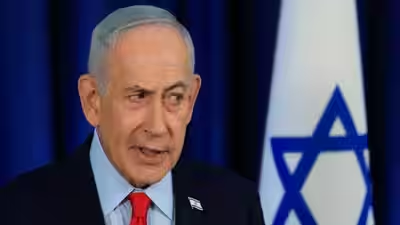
Benjamin Netanyahu is seeking an unprecedented seventh term as Israel’s prime minister as the country prepares to elect members of the 120-seat Knesset on October 27.With the vote approaching on Tuesday, the rulong Likud bloc is locked in a close contest with the Yashar party, founded by former army general Gadi Eisenkot, who has emerges as Netanyahu’s principal challenger.As Israel heads to the polls, here’s a look at Eisenkot and Netanyahu’s other challengers.
Gadi Eisenkot
The former army chief, 66, is the son of Moroccan immigrants and has emerged as Netanyahu’s main rival. A centre-right politician, he founded the Yashar party in 2025 after resigning from Netanyahu’s war cabinet in 2024 and has since been a vocal critic of the prime minister.Also Read | Who is Gadi Eisenkot? Ex-army chief of Israel is Netanyahu’s biggest challenger in PM raceEisenkot has vowed to end Hamas’s rule in Gaza within 18 months and opposes the creation of a Palestinian state. He supports Israeli settlements in West Bank but has pledged to crack down on settlers who attack Palestinians.He has also drawn public sympathy after his son Gal and two nephews were killed in combat during the Gaza war. If elected, he would become Israel’s first prime minister of Middle Eastern or North African descent.
Naftali Bennett
A former prime minister himself, Bennett, 54, leads the centre-right Beyahad party, which is polling third. A former tech entrepreneur and son of US immigrants, he rose to prominence in Israel’s nationalist right and settler movement before repositioning himself as a secular centrist.In 2021, he formed an unprecedented coalition spanning the political spectrum, including an Arab party, ending Netanyahu’s 12 consecutive years in power. However, Bennett’s government lasted just a year.Bennett is seeking to attract right-wing voters disillusioned with Netanyahu, though he has left open the possibility of including the incumbent prime minister in an opposition-led coalition despite their political rivalry.
Yair Lapid
A former television journalist, Lapid founded the centrist Yesh Atid party in 2012 and quickly emerged as one of Netanyahu’s leading opponents. The 62-year-old has served as finance and foreign minister and briefly held the premiership in 2022 under a power-sharing deal with Naftali Bennett, with whom he is once again allied.A staunch secularist, Lapid maintains a strong social media presence and frequently criticises Netanyahu. However, his support remains concentrated among urban and secular voters, limiting his appeal beyond his core base.
Avigdor Lieberman
Lieberman, who was born in Soviet Moldova in 1958, immigrated to Israel in the late 1970s and became a prominent figure in its political scene. A hardline nationalist on security and a staunch secularist, he is the founder of the Yisrael Beiteinu party, initially drawing support from Russian-speaking voters before expanding his base.Once a close ally of Netanyahu, Lieberman is now a vocal critic of the prime minister, whom he has accused of failing on security. He has served as Israel’s foreign, defence and finance minister.
Mansour Abbas
Leader of the Arab-Israeli Raam party, Abbas is seeking to mobilise Arab voters, who make up about 20% of Israel’s population. A former dentist, Abbas made history in 2021 when Raam became the first Arab party to join an Israeli governing coalition, led by Naftali Bennett.Abbas could again play a pivotal role in coalition-building if opposition parties rely on his lawmakers to keep Netanyahu out of power. He has vowed to mobilise voters against Netanyahu’s government, which he has described as “racist” and “fascist”.Seeking to broaden Raam’s appeal, Abbas has included former police official Yoav Segalovitz, an Israeli Jew, on the party’s candidate list.
Yair Golan
Golan leads The Democrats, which represents Israel’s mainstream left and incorporates remnants of the Labour Party, which dominated national politics during the country’s first three decades.A former senior military officer, Golan backs a two-state solution to the Israeli-Palestinian conflict and supports liberal social policies, including same-sex marriage and public transport on the Jewish Sabbath.When Hamas attacked Israel on October 7, 2023, Golan volunteered to return to duty and drove into affected areas, personally rescuing people in his car.(With AFP inputs)