
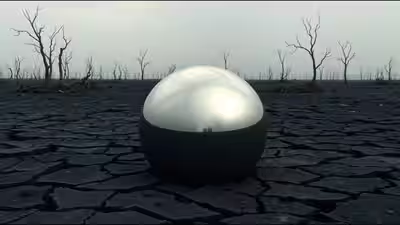
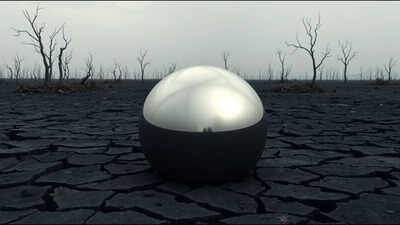
On March 27, 1974, the Betz family walked their fire-damaged property on Fort George Island, Florida, and came across something that did not belong there. Sitting in the open, untouched by the flames that had scorched the ground around it, was a gleaming metal sphere roughly the size of a bowling ball, eight inches across and weighing close to 22 pounds. It showed no rust, no scorch marks and no obvious sign of where it had come from. The family first assumed it was a Spanish colonial cannonball left behind from Florida’s early history. Within days, though, the sphere seemed to take on a life of its own, rolling across floors, vibrating and reportedly reacting to music, setting off a chain of events that pulled in journalists, ufologists and eventually the United States Navy.
Why the Betz family doubted their first explanation for the sphere
The idea that the sphere was an old Spanish cannonball fell apart almost as soon as the family looked closer. Spanish colonial weaponry from that era was typically made of iron or stone, not the polished, corrosion-resistant metal sitting in their yard. According to reporting later compiled by public broadcaster WJCT, whose podcast archive draws on original 1974 coverage from the Florida Times-Union and the St Petersburg Times, the sphere’s spotless condition and unusual composition immediately set it apart from any plausible historical relic, leaving the family with more questions than answers about what they had actually found.
How the sphere appeared to move and react on its own
Once inside the Betz household, the object’s behaviour only grew stranger. Gerri Betz told the St Petersburg Times in an April 1974 interview that the family dog began whimpering and covering her ears with her paws whenever she got close to the sphere, a reaction the family had never seen from the animal before. Son Terry reported that the sphere seemed to respond to guitar music with a low throbbing sound, while family members said that rolling it across the floor toward one another sometimes caused it to change direction midway and roll back on its own. The family’s early theory centred on sunlight, since they believed the sphere grew more active whenever direct sun struck its surface.
What happened when the US Navy stepped in to investigate
As word of the sphere spread through local and national press, outside investigators began taking an interest. According to the WJCT Public Media archive documenting the case, Navy Chief Chris Berninger detailed the results of an X-ray spectrographic and emission test conducted on the sphere in an April 13, 1974 report published by the Florida Times-Union. The Navy’s first attempt to X-ray the object reportedly failed because the machine was not powerful enough to penetrate the steel, though later tests succeeded in revealing its interior structure. Officials ultimately concluded the sphere was not explosive, posed no danger and had been manufactured on Earth, while declining to identify exactly what it was or who had made it.
Why the mystery persisted despite an official Navy conclusion
Even after the Navy’s findings, the story refused to die down. The family also sent the sphere to astronomer and prominent ufologist J. Allen Hynek, who examined it as part of a panel convened around the same time and likewise concluded the object was human-made. Two separate investigations reached the same basic verdict: terrestrial, harmless and of unknown specific origin. That kind of open-ended, officially unresolved explanation proved to be exactly the wrong note to end on during the cultural climate of the mid 1970s, a period when public fascination with UFOs and paranormal phenomena was running high, and the sphere’s odd behaviour fit neatly into that appetite for unexplained mystery.
What later reporting suggests actually explains the sphere
A more mundane explanation surfaced not long after the Navy’s tests became public. A Jacksonville equipment supply company president named Robert Edwards came forward after seeing news coverage, saying his company stocked Bell and Howell stainless steel balls that were eight inches in diameter and weighed just over 21 pounds, a close match for the object found on the Betz property. Investigators also identified the sphere’s metal as type 431 stainless steel, an alloy commonly used in aircraft fasteners and bolts, and about as far from an exotic or extraterrestrial material as steel manufacturing gets. As for the self-directed rolling, the Navy’s own assessment pointed to the uneven, ageing stone floors inside the Betz home, reasoning that a heavy, well-balanced sphere would only need a slight dip in the floor to shift direction without any outside force involved.
Why an ordinary explanation never fully caught up with the legend
More than five decades later, the Betz sphere still circulates in podcasts and online discussions debating whether it was a dormant piece of military hardware or something stranger altogether. What the case illustrates most clearly is not evidence of alien technology, but how quickly an unresolved gap in an official explanation can turn an ordinary object into an extraordinary story. A misplaced industrial ball bearing, cleared into view by a brush fire on a quiet stretch of Florida coastline, ended up defined less by what it actually was than by how comfortably it fit into a moment already primed to believe in mysteries left open.