

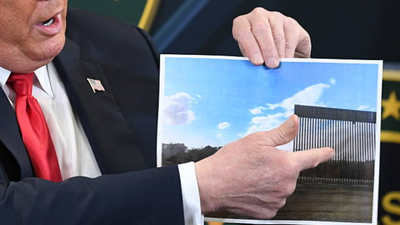
US President Donald Trump has a penchant for dreaming up big projects, from his long-promised wall along the US-Mexico border to sweeping plans for reshaping federal buildings and public spaces. But one of his most ambitious border-security projects has run into a legal battle over its impact on one of America’s most striking natural landscapes. On November 9, the US Supreme Court cleared the way for his administration to resume construction in Texas’s Big Bend region, just 38 days after a federal judge ordered work to stop over concerns that the government had exceeded its authority to bypass environmental laws, as per a report by CBS News.The ruling allows construction of border barriers and related infrastructure across the Big Bend sector, which covers more than 500 miles of the US-Mexico border and includes Big Bend National Park. The Supreme Court’s decision temporarily pauses a lower court’s injunction while the legal challenge continues. It does not settle the underlying dispute over whether the administration can lawfully proceed with the project. The case has become a major test of how far the federal government can go in using its authority to accelerate border construction, particularly in environmentally sensitive areas.
Why did a judge halt construction?
The dispute began after the Department of Homeland Security (DHS) announced plans in February 2026 to expand border barriers and roads through the Big Bend region. Then-Homeland Security Secretary Kristi Noem issued waivers allowing construction to bypass several federal environmental and historic-preservation requirements. Her successor, Markwayne Mullin, issued additional waivers. The administration invoked a 1996 federal immigration law that gives the DHS secretary authority to waive legal requirements considered necessary to ensure the rapid construction of border barriers and roads near the southern border.The project includes 30-foot-tall steel bollard walls in certain areas, vehicle barriers, patrol roads and surveillance infrastructure. Government filings described plans for barriers and roads extending more than 300 miles in the region, although the wider Big Bend Border Patrol sector covers approximately 517 miles.Environmental groups, a local river guide and a religious organisation challenged the waivers in court in April. They argued that the administration had used a law intended to address areas of high illegal entry to justify construction in a region that records some of the lowest migrant apprehension numbers along the US-Mexico border.On October 2, US District Judge Kathleen Cardone granted a preliminary injunction, stopping construction and other ground-disturbing activities across the Big Bend sector. In her subsequent written opinion, she found that the challengers were likely to establish that the administration had exceeded its authority when issuing the waivers. The judge also questioned the government’s description of Big Bend as an area of high illegal entry. The plaintiffs pointed out that the sector accounts for a relatively small share of apprehensions despite covering a substantial portion of the border.
What did the Supreme Court decide?
The Trump administration appealed to the Supreme Court, arguing that the lower court’s order was obstructing its ability to secure the border and combat drug trafficking and illegal crossings. On November 9, the justices granted the administration’s emergency request and temporarily lifted the injunction. The unsigned decision said the lower court’s order was delaying construction and impeding the government’s ability to advance its interests in border security. Justice Ketanji Brown Jackson was the lone dissenter, saying she would have rejected the administration’s request for emergency relief.The ruling is an interim victory for Trump, but it does not mean the environmental groups have lost their lawsuit. The legal challenge will continue, and the Supreme Court’s decision allows construction to proceed while the broader questions are considered.The administration has argued that more than 89,000 people attempting to cross into the US illegally were apprehended in the Big Bend sector between 2021 and 2025. It has also cited drug seizures and the activities of criminal cartels in neighbouring parts of Mexico, warning that leaving gaps in border protection could encourage trafficking and illegal entry. The challengers, however, maintain that the region’s rugged terrain already makes illegal crossings difficult and that the scale of the proposed construction is unnecessary.
Why is the Big Bend region controversial?
The proposed project has drawn attention because of the landscape it could alter. Big Bend is known for its desert ecosystems, dramatic canyons, mountains and the Rio Grande, which forms part of the US-Mexico boundary. The wider area includes Big Bend National Park, Big Bend Ranch State Park and sections of the Rio Grande Wild and Scenic River corridor.Environmental groups and local residents argue that construction could fragment wildlife habitats, damage historic and cultural sites, disturb vegetation and affect access to the river. They have also raised concerns about the consequences for tourism, ranching and businesses that depend on the region’s natural landscape. The opposition has extended beyond environmental organisations. Local landowners, cattle ranchers, river guides and politicians from both parties have questioned whether a large physical barrier is necessary in an area with relatively low migrant apprehension numbers.The administration, meanwhile, says it is not planning to construct a continuous 30-foot pedestrian wall through Big Bend National Park itself. Customs and Border Protection has said the park would instead see patrol roads, surveillance equipment and approximately 17 miles of vehicle barriers. The broader project also involves construction on private and public land outside the park.
A much larger border-wall ambition
The Big Bend project is part of Trump’s wider effort to expand physical barriers along the southern border, a promise that has been central to his immigration agenda for more than a decade. Congress allocated approximately $46 billion for border-wall projects, allowing the administration to accelerate construction across several sections of the frontier. The Big Bend portion has been particularly contentious because of its ecological and cultural significance. According to reporting by The Washington Post, the project in the region has been estimated at around $1.7 billion.Construction activity had already begun in parts of the area before the legal intervention. Images of bulldozers clearing land near Big Bend National Park triggered criticism from environmentalists and lawmakers, prompting officials to announce a temporary pause on work inside the park.With the Supreme Court now allowing construction to resume, the administration can move ahead while the lawsuit remains unresolved. For conservationists and local communities, however, the concern is that damage to the desert, river corridor and wildlife habitats could be difficult to reverse even if the courts eventually rule against the project.