
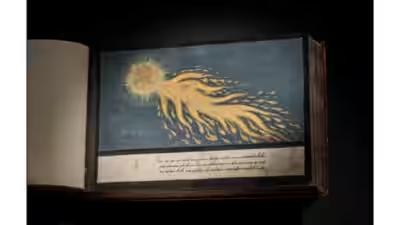
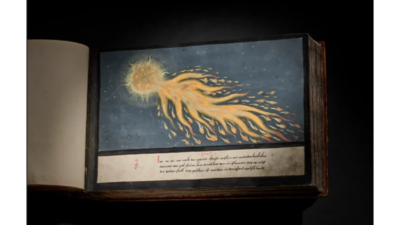
A 16th-century illustrated manuscript featuring blood rain, five suns, devastating floods and mysterious objects in the sky could sell for up to £1 million at an auction in London on December 10.Known as the Book of Miracles, the rare volume contains 167 paintings documenting unusual natural events and apocalyptic visions. Produced in Augsburg, Germany, during the 1550s, it will be offered at Christie’s with an estimated price of £700,000 to £1 million.One illustration shows five suns appearing over Leipzig in 1551, while another depicts blood rain falling over Rome in 1456. A third, dated 1552, portrays enormous hailstones striking the Dutch city of Dordrecht during a storm so severe that people feared the arrival of Judgment Day.
A forgotten manuscript discovered in a German castle
The manuscript remained unknown to scholars for centuries before it was discovered in the library of a small Baroque castle in southern Germany nearly 20 years ago.It was sold in 2008 alongside the castle’s furniture, carpets and other belongings for just over £100,000. Shortly afterwards, it entered the private collection of Mickey Cartin, a prominent contemporary art collector from Connecticut, The Guardian reported.The December auction will give public institutions their first opportunity to acquire the manuscript since scholars learned of its existence. Members of the public can also view it during a six-day exhibition before the sale.Despite scholarly interest, its original purpose remains unknown. It is the only known surviving copy.
Paintings capture fears of the 16th century
The 167 illustrations record events that people of the period often interpreted as divine warnings. They include a swarm of locusts reaching Poland in 1527 during what the manuscript describes as a terrible wind, and a North Sea flood that struck the coast of Frisia in 1230, in present-day Netherlands and Germany.Other paintings depict comets, eclipses and unusual formations in the sky. An illustration showing dragons flying over Bavaria in 1533 is believed by scholars to represent the northern lights.Each painting has a German caption identifying the event, its location and the date.Eugenio Donadoni, Christie’s international specialist in medieval and Renaissance manuscripts, described the volume as an exceptionally rare German wonderbook.“German wonderbooks functioned as the sensationalist mass media of their day,” Donadoni told The Guardian.He said Lutheran theologians, including Martin Luther and Philip Melanchthon, used such accounts to support their religious interpretations of the end times. However, the manuscripts also recorded reported natural phenomena through eyewitness accounts, dates and geographical details.
Modern science offers explanations for some events
Some of the unusual occurrences depicted in the book have scientific explanations. The five suns over Leipzig, for example, are thought to represent a parhelion, commonly known as a sun dog. The optical phenomenon occurs when sunlight passes through ice crystals in the atmosphere, creating bright patches that resemble additional suns.Blood rain can occur when red dust particles, often originating in the Sahara, mix with water droplets in rain clouds.“Many of these things have actual rational scientific explanations to them,” Donadoni told the outletHe compared reading the manuscript in the 1550s to following a constant stream of alarming news online, describing it as a possible 16th-century version of “doomscrolling”.The illustrations, painted in watercolour and gouache, could also attract modern art collectors because of their surreal appearance.Till-Holger Borchert, director of the Suermondt-Ludwig Museum in Aachen, Germany, who has studied the manuscript, called it “one of a kind”. He described the £1 million estimate as “very conservative”, suggesting the final price could be higher.A facsimile edition published in 2013 introduced the manuscript to a wider audience. Borchert said it had since become an icon among people interested in apocalyptic imagery.He argued that its significance extends beyond its historical record, telling newspaper: “It’s more than that. It speaks to us, to our generation.”