
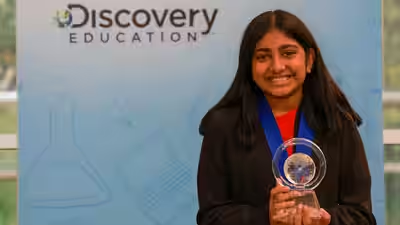
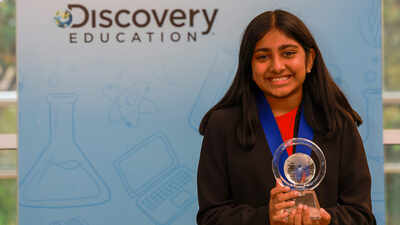
At 13, Raji Doshi is already thinking about a problem that scientists around the world are racing to solve: what happens when the oceans absorb too much carbon dioxide? The Connecticut student has developed a potential way to tackle ocean acidification using algae and a naturally occurring mineral, earning her the top prize at one of America’s leading science competitions for middle school students, states an online report by 3BL media.
A young scientist takes the top spot
According to 3BL media, an eighth grader from Farmington, Connecticut, Doshi was named the 2026 winner of the 3M Young Scientist Challenge, a national competition organised by 3M and Discovery Education. The title came with a $25,000 prize and the distinction of being named America’s Top Young Scientist, the report adds.Doshi emerged from a field of 10 finalists aged between 11 and 14, each tasked with identifying a real-world problem and developing a scientific solution. The finalists spent the summer refining their projects with the guidance of 3M scientists before presenting their work at 3M’s global headquarters in St. Paul, Minnesota, on October 12 and 13.
Turning algae into a climate solution
Doshi’s project focuses on ocean acidification, a consequence of rising carbon dioxide levels that can threaten marine ecosystems and organisms that depend on calcium carbonate to build shells and structures, the report informs.Her system, called ALKACORE, combines macroalgae cultivation with aragonite, a natural form of calcium carbonate. The idea is to increase the alkalinity of seawater while helping remove carbon dioxide, potentially creating a durable and relatively low-cost approach to reducing coastal acidification.Her research went beyond lab work. Doshi investigated how aragonite affects algal growth and carbon dioxide using carbonate chemistry. She also developed a Michaelis-Menten computational model to identify an optimal aragonite dose, an important step towards exploring how such a system could eventually be adapted for practical use, the report adds.The inspiration was also deeply personal. Her interest in seashells led her to notice the damage that increasing ocean acidity can cause to shell-forming marine life, turning a childhood curiosity into a scientific investigation, explains the 3BL media report.
Two more Indian-origin finalists shine
Doshi was not the only Indian-origin student to make her mark in this year’s competition. Aaisha Asif, a seventh grader from Sarasota, Florida, and Sharvi Mahajan, a ninth grader from San Diego, California, claimed second and third place respectively. Both runners-up received $1,000 prizes, giving the competition a strong showing from young Indian-origin innovators.
Where curiosity can lead
Now in its 19th year, the 3M Young Scientist Challenge is designed to give middle school students an opportunity to turn curiosity into practical scientific work. Each finalist is paired with a 3M scientist for one-on-one mentoring, helping students develop their ideas, test solutions and communicate their findings. The competition has also become a launchpad for young innovators, with previous winners going on to pursue patents, launch nonprofits, deliver TED Talks and earn places on the Forbes 30 Under 30 list.Image Courtesy: 3BL Media