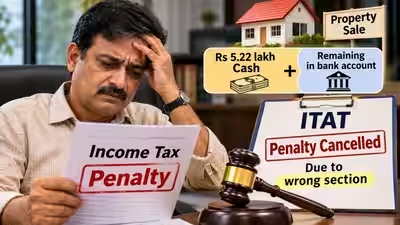

In cases of property deals, cash transactions are allowed up to a certain limit. What if you sell a property and take a part in cash and the Income Tax Department imposes a penalty?In one case, the assessee faced a tax penalty but managed to get relief, but only on a technical ground. Read on to find out why the Income Tax Appellate Tribunal (ITAT) ruled in favour of the property seller.
What the case is about
A property owner sold it and accepted Rs 5.22 lakh in cash while the balance amount was received in his bank account. Income tax provisions prohibit the receipt of more than Rs 2 lakh in cash in such transactions.The Income Tax Assessing Officer (AO) in Berhampur received information from the property registrar’s office in Jharsuguda that the man had sold a property and collected Rs 5.22 lakh in cash as part of the payment. The registered sale deed also mentioned the cash component.Following this information, the AO issued the man a notice under Section 269SS of the Income Tax Act and levied a penalty under Section 271DA.The Income Tax Appellate Tribunal (ITAT), Cuttack, has granted relief to the man.
Why did ITAT rule in favour of property seller?
Appearing for the man before the ITAT Cuttack, his counsel argued that the AO had relied on Section 269SS to treat the cash received as sale consideration as a violation of income tax law.However, the counsel contended that Section 269ST, which came into effect from AY 2017-18, was the provision applicable to this particular violation.To substantiate his argument, the counsel referred to an earlier ITAT Cuttack ruling in the case of Arati Saraf (ITA No. 375/CTK/2023), dated May 13, 2024.He drew the tribunal’s attention to the ITAT Cuttack’s ruling in the Arati Saraf case, in which the tribunal had examined a similar issue.In that matter, the Assessing Officer had invoked Section 269SS of the Income Tax Act and imposed a penalty under Section 271D for cash received during the sale of immovable property.However, Sections 269ST and 271DA had been introduced to deal with violations involving cash transactions exceeding Rs 2 lakh.The counsel argued that the AO had failed to invoke the relevant provisions in this case, even though the transaction fell under Section 269ST.In its ruling in the Arati Saraf matter, the ITAT Cuttack had also explained the legislative intent behind the provision.The tribunal referred to the memorandum and notes on clauses accompanying the Finance Bill, 2015, which made it clear that the amendment was intended to curb the generation of black money in real estate transactions by prohibiting the acceptance of specified advances in cash.It observed that the term “specified sum” applied only to an “advance” receivable, while the expression “advance otherwise” meant that the advance could take any form.The tribunal further held in Arati Saraf’s case that the provision did not apply where no cash advance had been received and the cash payment was made at the time the sale deed was registered.Arati Saraf’s case fell into this category because, as admitted, the entire cash amount had been received in a single payment when the sale deed was executed. The ITAT Cuttack therefore concluded that Section 269SS had not been violated and had been wrongly invoked in that transaction.In this matter, the ITAT Cuttack relied on the reasoning in Arati Saraf and found that the facts clearly established that Section 269SS was not applicable to the transaction for which the AO had imposed a penalty under Section 271D.The tribunal observed: “This being so, respectfully following the decision of the coordinate bench of this Tribunal in the case of Arati Saraf as also in the case of Satyabrata Panda, as it is noticed that the AO has applied the provisions of Section 269SS in this case instead of applying the provisions of Section 269ST; therefore, the penalty levied under Section 271D stands cancelled.”Consequently, on October 5, 2026, the ITAT Cuttack ruled in the man’s favour and cancelled the penalty.