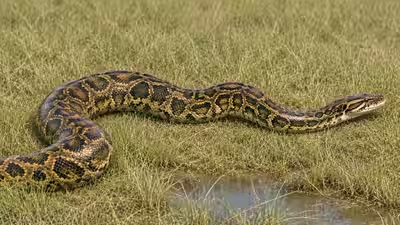
Florida’s Everglades is facing an ecological challenge from one of its most notorious invasive predators, the giant Burmese python. The snakes have devastated populations of native mammals and disrupted the delicate balance of the wetland ecosystem. However, scientists have uncovered another, less obvious way these reptiles may be influencing the landscape. New research suggests that Burmese pythons could be helping plants spread by transporting seeds after consuming fruit-eating birds and mammals. Researchers identified 25 different seed types in the digestive tracts of the snakes, revealing that their ecological influence extends beyond hunting and feeding. This means the pythons could unintentionally act as seed carriers, transporting seeds from one location to another through their prey. Some seeds can even survive the digestive process and remain capable of germinating, potentially allowing plants to grow in new areas of the Everglades. The discovery offers a surprising insight into how an invasive predator can alter an ecosystem through unexpected biological interactions.
Scientists found 25 types of seeds inside Burmese pythons
The findings come from a study published in the Journal of Zoology, titled Double agents: Invasive Burmese pythons (Python bivittatus) and Argentine black and white tegus (Salvator merianae) as potential seed dispersers in South Florida. The research involved scientists from the University of Florida, the US Geological Survey and the Conservancy of Southwest Florida.Researchers examined digestive tract samples collected from invasive Burmese pythons in South Florida and identified 25 different seed types. These included seeds from native plants such as cabbage palm and creeping cucumber.The discovery suggests that pythons can unintentionally transport seeds after consuming birds and mammals that have previously eaten fruits. The seeds remain inside the snakes’ digestive systems and may eventually be deposited at different locations.This process is known as secondary seed dispersal. Unlike animals that directly consume fruits and distribute their seeds, Burmese pythons can move seeds indirectly by eating animals that already carry them.
Nearly 40% of some seeds survived the digestive process
One of the more significant findings involved cabbage palm seeds, which showed an ability to survive passage through a python’s digestive system.Germination experiments found that nearly 40% of these seeds survived digestion and subsequently sprouted. This suggests that the snakes may transport viable seeds across different parts of the Everglades rather than simply destroying them during digestion.Seed survival is an important factor in determining whether an animal can contribute to plant dispersal. If seeds remain capable of germinating after passing through a predator’s digestive tract, they may establish themselves in locations far from the original fruit-bearing plants.The findings also raise questions about which plant species could benefit from this unusual form of transportation. Both native and invasive plants could potentially be affected, depending on which seeds are carried and where they are deposited.
Burmese pythons have already devastated Everglades wildlife
Burmese pythons are native to Southeast Asia but have become established across South Florida, particularly in the Greater Everglades ecosystem. Their presence is considered a major threat to native wildlife because of their size, appetite and ability to hunt a wide variety of animals.The snakes prey on mammals and birds, including raccoons, rabbits, opossums and other native species. Their expansion has contributed to substantial declines in several mammal populations across parts of the Everglades.These animals also perform important ecological functions, including seed dispersal. By consuming fruits and carrying seeds to different locations, fruit-eating mammals and birds help maintain plant populations and vegetation diversity.As python populations expand and native animal communities change, the movement of seeds across the ecosystem may also be affected. The snakes’ unexpected role as secondary seed carriers adds another layer to an already complicated ecological relationship.
Researchers also studied invasive tegu lizards
The research examined another invasive reptile in South Florida: the Argentine black and white tegu (Salvator merianae).Unlike Burmese pythons, which primarily act as predators, tegus are omnivorous reptiles that directly consume fruits and seeds. Researchers identified 73 different seed types in tegu samples, compared with 25 in Burmese pythons.Together, the two reptiles were associated with seeds belonging to 38 plant families, including native, endangered and invasive species.The researchers also used a binary interaction network to examine how these reptiles interact with different plant species and potentially become integrated into existing seed-dispersal networks.Their findings suggest that invasive reptiles can influence plant distribution through multiple pathways, from directly eating fruits to consuming animals that have already ingested seeds.
An unexpected dimension of invasive species
The study highlights how invasive animals can influence ecosystems through interactions that are not immediately visible. Burmese pythons are primarily recognised for their impact on native wildlife, but their feeding habits may also affect the movement of plant seeds.The researchers’ findings point to the possibility that invasive reptiles could become part of the ecological networks they initially disrupt. Their presence may influence which plants spread, how seeds move and how vegetation patterns develop across the Greater Everglades.The research was published in the February 2026 issue of the Journal of Zoology, with the study first appearing online on November 9, 2025.