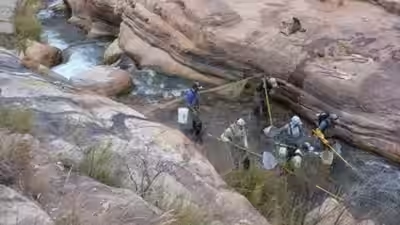
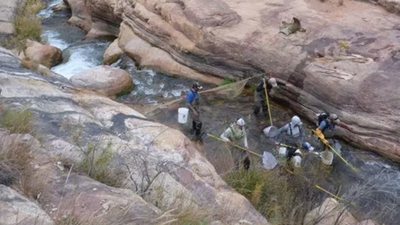
At least five of the Grand Canyon’s eight species of native fish were historically found in Bright Angel Creek. However, these species that are uniquely adapted to the characteristics of the Colorado River and its tributaries have suffered serious declines over the years due to human-caused changes to their habitat. The creek once supported a large number of native fish, including the endangered humpback chub. Humpback chub were first scientifically described from specimens collected in or near Bright Angel Creek. But over the years, it became the main spawning site for non-native brown trout, which are predators of the native population.In 2006, the National Park Service began a multi-year project to reduce the number of non-native brown and rainbow trout to benefit the native fish population. The project was funded by the Bureau of Reclamation and National Park Service, with staff contributions by the University of Missouri and volunteers provided by the Grand Canyon Trust.
Humpback chub translocation
Alongside efforts to suppress non-native trout, conservationists have also worked to establish and protect humpback chub populations in other parts of the Colorado River system. The endangered fish has been translocated to suitable habitats in the Grand Canyon, including areas where non-native predators pose less of a threat. These efforts aim to improve the species’ chances of survival by expanding its distribution and reducing the risks associated with relying on a limited number of spawning and rearing locations.
Native vs non-native
Robust populations of native fish are important indicators of an aquatic ecosystem’s overall health. National Park Service Management Policies require that species and natural ecosystems are preserved, and that recovery actions are taken when park resources have been damaged or compromised. A variety of laws, including the Endangered Species Act, require the protection of rare or endemic species.Trout species are not native to the Colorado River and its tributaries in the Grand Canyon. As recently as the 1970s, brown trout were rare in the creek. Brown and rainbow trout were stocked in the Grand Canyon in the first half of the last century before the existence of current environmental regulations and the development of ecological knowledge of aquatic systems. Much of the diet of brown trout in Grand Canyon consists of fish, and they preferentially consume native fish. As their populations increased, there was a corresponding decline in the native fish population.This is where the Bright Angel Creek Trout Reduction Project came in to protect endangered humpback chub and other native fish species in the river and restore and enhance the native fish community. Biologists used two methods for capturing and removing non-native trout in the lower reach of the creek during the winter months: a weir and electro-fishing. The weir captured large trout that live in the Colorado River as they entered Bright Angel Creek to spawn. Electro-fishing allowed fisheries biologists to monitor and assess the fish population of the creek and also remove non-native trout that live in the stream.
Assessing the results
To date, the Bright Angel Creek Trout Reduction Project has been implemented four separate times during the fall and winter seasons of 2002-2003, 2006-2007, 2010-2011, and 2011-2012. The weir appears to be an efficient way to capture spawning trout. For example, in the 2010-2011 effort, 105 mature brown trout and 107 rainbow trout were captured and removed using the weir.Electro-fishing techniques enable biologists to both monitor native and non-native fish populations and remove non-native fish from the stream. In 2010-2011, biologists removed 594 brown trout and 454 rainbow trout in lower Bright Angel Creek by electro-fishing, estimated to be between 55 and 89% of the trout that were present.The weir has captured larger brown and rainbow trout, up to 25 inches (634 mm) in length, much longer than those captured using electro-fishing equipment. These larger fish carry proportionally more eggs (as much as 20% of their weight) and, because of their size, are more likely to consume native fish. Electro-fishing also allows biologists to collect a wider size range of trout from Bright Angel Creek and allows for biologists to estimate the population size for both the native and non-native fish species.An important goal of the fisheries program is fostering meaningful tribal relations and integrating tribal knowledge and perspectives into its decisions and practices. The program employs a beneficial use policy for all trout removed from the stream, as appropriate, following recommendations received through consultation with traditionally associated tribes. Eleven tribes have cultural connections with the Grand Canyon, including the Pueblo of Zuni, who consider waters connected to Bright Angel Creek and the Colorado River sacred.Following this successful suppression of invasive trout in Bright Angel Creek, native fish populations increased by over 400%, and young flannelmouth suckers were observed rearing in the creek for the first time since brown trout came to dominate the creek