

A glass of water usually begins somewhere familiar, such as a tap, bottle, reservoir or river. Seventh-grader Ankith Burki found another possibility in the moisture that already surrounds us. He built a machine that cools air enough for its water vapour to condense, creating droplets that can be collected as liquid water. But Ankith did not stop at getting the system to work. He wanted to know whether sound could change how much water the machine collected. After running a series of four-hour experiments with and without low-frequency sound, he found that a sine wave produced 117% more collected water than the silent tests. Ankith will present his project at the finals, scheduled for October 23–28 in Washington, DC.
How Ankith’s prototype cooled air enough to collect water
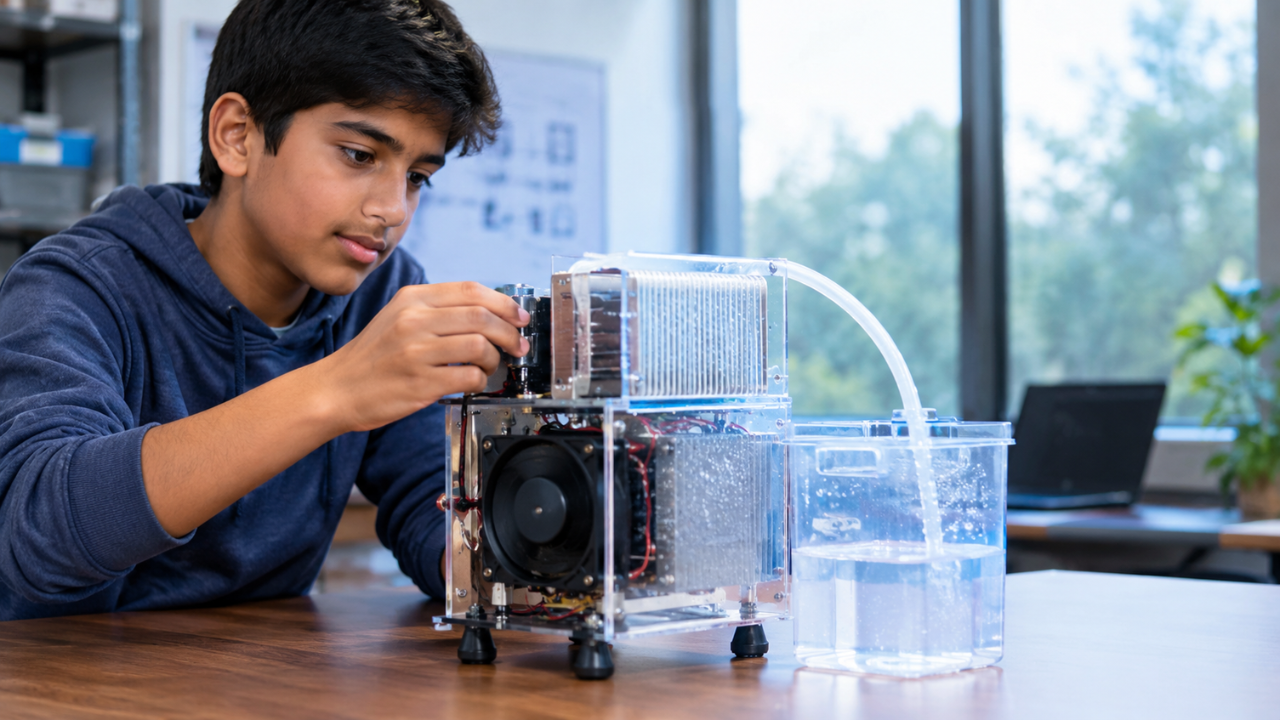
The first part of the project was getting the water generator itself to work. Ankith designed a prototype that used the Peltier effect, a thermoelectric process in which an electric current moves heat from one side of a material to the other.For atmospheric water generation, the principle is relatively direct. Air contains water vapour, and when a surface is cooled below the surrounding air’s dew point, that vapour can condense into droplets. The challenge is getting the cooling system cold enough while maintaining a practical rate of water collection.Ankith went through several attempts before reaching a working design. As reported by the Society for Science, his final prototype was able to lower the temperature around the system by 7.5°C. That reduction took the surface below the local dew point, allowing moisture from the surrounding air to condense and collect. It gave him a functioning machine to use for the next stage of the experiment.
Ankith tested sound-assisted condensation in his atmospheric water generator
Once the generator was producing water, Ankith began comparing its output under different sound conditions. He carried out four-hour tests, with five runs conducted without sound and another 10 using low-frequency audio.Reportedly, the sound was delivered through a speaker and tested in two waveform patterns: a sine wave and a triangle wave. The idea was that vibrations produced by the sound could influence the behaviour of droplets as they formed, encouraging smaller droplets to come together. That meant the experiment was not simply about making the machine colder. The cooling system remained the basis of the water-generation process, while the sound was introduced as a separate variable. After each run, Ankith measured the amount of water collected. The comparison gave him a way to see whether the added vibration made a measurable difference.
PC: AI Generated
Ankith recorded a 117% increase in water collection with sine waves
The strongest result came from the low-frequency sine wave. Under that condition, the amount of water collected increased by 117% compared with the silent tests. The project also included tests using a triangle wave, allowing Ankith to compare two different forms of low-frequency sound rather than treating all sounds as the same. His measurements suggested that the effect depended on the waveform being used.The finding points to a possible relationship between acoustic vibration and condensation inside a thermoelectric atmospheric water generator. In the experiment, sound was being used to influence the droplets after moisture had been drawn from the air and cooled into liquid form.
Ankith adds low-frequency sound to atmospheric water generation
Ankith began with the wider problem of access to fresh water. Atmospheric water generators appealed to him because they can collect moisture already present in the air rather than relying on a conventional surface-water source.The technology is not without limitations. The amount of moisture available depends on atmospheric conditions, while cooling air to produce condensation requires electricity. Improving how efficiently a machine collects that moisture is therefore an important part of making the approach more practical.His project focused on a relatively simple question: whether introducing low-frequency sound could help more of the condensed moisture become collectable water. Rather than redesigning the entire concept of atmospheric water generation, he added an acoustic element to an existing type of cooling process.
How music and engineering shaped Ankith’s water experiment
The interest in sound also sits alongside another part of Ankith’s life. He is a singer who performs Indian Carnatic classical vocal music, a tradition he has practised through his family and cultural background. He has described music as a way of connecting with traditions passed down through generations. His work on the water generator took sound in a very different direction, using it as an experimental variable rather than as a form of musical expression.The project has also shaped his plans for the future. Ankith would like to work as an environmental engineer, with an interest in developing practical solutions for environmental problems. For him, that ambition is tied to making technology available beyond people who have abundant resources. He has said that he has not experienced significant personal hardship and sees that as a reason to think about how engineering could serve people with fewer resources and opportunities.