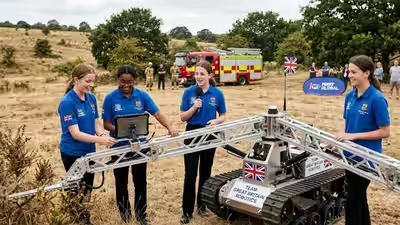
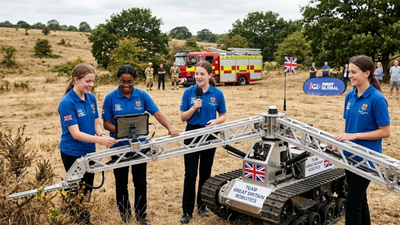
Five schoolgirls from Kent, aged between 14 and 15, have built a robot with five-metre folding arms to help fight wildfires. Their work has earned them the chance to represent Great Britain at an international robotics competition in South Korea. The team from The Folkestone School for Girls, known as Team Meglabyte, designed the robot to clear dry plants and create paths that remove fuel from the spread of fires. The school’s robotics club was only founded in 2024, but it has now been chosen to represent Great Britain at the FIRST Global Challenge in Incheon.
Designing a solution to growing wildfire risks
The international competition brings together student teams from more than 190 countries to work on major environmental and technology problems. This year’s challenge focuses on preventing, controlling and recovering from wildfires in a warming world. For the competition, the Folkestone students designed an autonomous vehicle with long, folding arms that can clear paths up to five metres wide through dry vegetation. The system removes plants and other surface material that can fuel a fire, creating natural firebreaks that can slow the spread of flames without putting firefighters directly in danger. According to a statement on the official website of The Folkestone School for Girls, the students have been working to improve the robot before the global competition: “The Folkestone School for Girls robotics team, Team Meglabyte, are thrilled to be representing Great Britain at the First Global Challenge in South Korea.”
Working with local firefighters
The five students worked with professional firefighters to make sure their design could deal with the real conditions faced during wildfires. According to a report by Kent news outlet Shepway Vox, the students spoke with Kent Fire and Rescue Service during the early stages of the project. The firefighters helped them understand how wildfires spread across difficult terrain. Their advice led the team to focus on building a lightweight and stable robot that could extend its arms across uneven ground without tipping over. The students also used standard parts supplied by the competition organisers to program the robot’s autonomous driving system. The software allows the machine to avoid obstacles, clear debris and work on its own in areas where thick smoke could make remote control difficult.
National selection and fundraising
The team’s success comes only two years after the school’s robotics program was created. Despite having less experience than some international teams, the Kent students won the national selection process and secured Great Britain’s single place in the competition. To help pay for their trip to Incheon and the materials needed to build their robot, the team launched a public crowdfunding campaign. On their official Crowdfunder page, the students explained their goal of representing Britain and encouraging more girls to study science and technology: “Our aim is to inspire young girls across GB into STEM and globally raise awareness about this year’s competition theme of wildfires. Each year a single robotics team from a school in Great Britain is sent to compete in a robotics competition on the global stage. This year, five girls from the all-girls state school Folkestone School for Girls have been selected to represent the nation in South Korea to compete with their robot. The girls need your help to get them to the competition!” The students are also using the opportunity to create outreach programs for primary schools. These projects will give younger pupils basic coding kits and lesson plans showing how engineering can be used to solve real environmental problems. The FIRST Global Challenge will take place in Incheon, South Korea, where the five Folkestone students will put their robot to the test against teams from countries around the world.