When Harry George “Ben” Hartman lost his job as an iron moulder at the Springfield Machine Tool Company during the Great Depression, he picked up a trowel and began digging a small concrete fishing pond in his backyard. That simple project soon grew across his entire residential lot. Over 12 years, Hartman built a huge folk art environment using more than 250,000 stones, concrete, metal scraps, wood and recycled glass. After his death in 1944, his wife Mary cared for the entire complex on her own for 53 years, protecting what became one of the leading folk art environments in the United States. According to documentation from the Friends of the Hartman Rock Garden and the Kohler Foundation, the property at 1905 Russell Avenue contains dozens of detailed stone structures, miniature landmarks and hundreds of hand-painted figures representing American history, religion, patriotism and popular culture.
From factory job to backyard creation
Born in Edenville, Pennsylvania, in 1882, Hartman moved to Springfield, Ohio, in 1912 to work in the city’s heavy machinery foundries. The economic collapse of 1932 ended his industrial career. Suddenly unemployed, Hartman turned his energy towards physical work and began transforming his suburban backyard into a massive construction project. Educational materials prepared for tours of the site say Hartman collected materials from nearby creek beds, rubbish dumps and gravel roads. He often asked his children to collect unusual stones, while friends and local visitors brought discarded glass bottles and pieces of ceramics that he used in the structures. Hartman spent long hours building the garden even after developing severe silicosis, a lung disease caused by years of exposure to dust in foundries. When he died from the illness in 1944 at the age of 61, the garden had spread across the entire residential yard.
Architecture, patriotism and personal expression
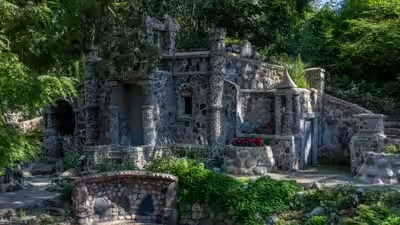
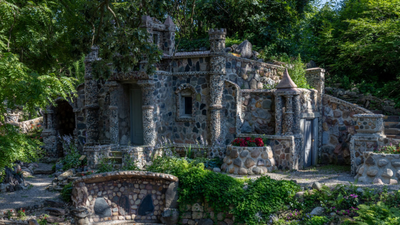
The centrepiece of the garden is the Tree of Life, a seven-foot concrete structure covered with river gravel and polished stones. Its branches hold miniature versions of a schoolhouse and church, while two doves of peace sit on either side and a carved American eagle stands at the top. Historical archives maintained by SPACES (Saving and Preserving Arts and Cultural Environments) show that Hartman also built several large architectural replicas directly on the lawn. One of the largest is The Cathedral, a 14-foot-high medieval-style stone building with detailed arches, niches and handmade figures of Jesus, Mary and several saints. The garden also contains scale models of Mount Vernon and the White House, as well as a replica of the Independence Hall clock tower. Hartman created other structures honouring figures including Abraham Lincoln, George Washington and Charles Lindbergh. The garden also includes stone versions of Noah’s Ark and covered wagons representing the Oregon Trail. Other parts of the garden show everyday American life, with miniature stone houses, bridges and working water wheels. “This is where it all began, this is the Hobby gone wild,” folk art collector Mark Chepp said during a historical tour recorded by public radio station WYSO. “Ben was a pacifist, and as you go through the garden and get involved and start looking at it, you see social commentary that comes through in a number of the objects.”
53 years of care
After Hartman’s death in 1944, his wife Mary took responsibility for the garden. For the next 53 years, she cut the lawns, cared for the flower beds, repaired damaged concrete and welcomed thousands of visitors who came to see the unusual garden along Russell Avenue. Mary continued giving visitors self-guided tours and showing them around the property until her death in 1997 at the age of 91. In 2008, the Kohler Foundation, a Wisconsin-based non-profit organisation focused on preserving visionary art environments, bought the property from the Hartman family estate. The foundation then began a major restoration project. Workers repaired damaged concrete, strengthened fragile stone structures and catalogued thousands of individual objects. In 2009, ownership was formally transferred to the Friends of the Hartman Rock Garden, a local non-profit organisation created to manage the site, maintain its seasonal flower displays and provide free public tours throughout the year. According to site curator Kevin Rose, writing in an interpretive study for SPACES, the garden remains freely open to visitors every day of the year. Tens of thousands of people from around the world visit the site to see the handmade legacy left behind by an unemployed foundry worker who turned his backyard into a remarkable work of folk art.