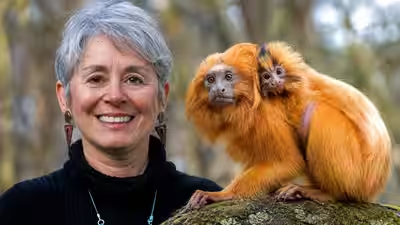
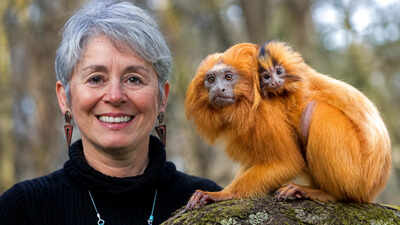
The small golden lion tamarin is one of Brazil’s most recognisable animals, but its presence on the R$20 banknote represents much more than national wildlife. The species (Leontopithecus rosalia) was once pushed dangerously close to extinction, with only about 200 animals remaining in the wild in the early 1970s. Brazil’s central bank describes the tamarin on the note as a symbol of the struggle to preserve endangered Brazilian species.According to Smithsonian’s National Zoo & Conservation Institute, its recovery became one of the landmark stories of modern primate conservation, and zoologist Devra G. Kleiman played a central role in building the programme that connected captive breeding, field research, education and the eventual return of captive-born animals to Brazil’s forests.
Devra Kleiman helped turn captive breeding into part of a wider conservation strategy
Devra Kleiman, a research zoologist at the Smithsonian’s National Zoo, became one of the key figures in this effort. The conservation programme she helped establish did not view zoos simply as places where endangered animals could be kept alive.In the 1986 conservation paper Conservation Program for the Golden Lion Tamarin, Kleiman and her co-authors argued that successful conservation required a combination of captive propagation, habitat protection, field research, management and public education.The paper specifically documented work on captive breeding and management, ecological studies and the reintroduction of golden lion tamarins into Brazil. Kleiman and her colleagues described scientifically managed captive populations as a way of preserving genetic diversity while simultaneously supporting conservation of the species in its natural environment.The Smithsonian Archives also preserves Kleiman’s records from the programme, including material documenting the capture, mating, release and reintroduction of golden lion tamarins in Brazil.
The golden lion tamarin was pushed towards extinction by the loss of Brazil’s Atlantic Forest
Golden lion tamarins are found naturally only in the Atlantic Forest of southeastern Brazil, where they live among trees, vines and epiphytes. Their decline was closely linked to the destruction and fragmentation of this habitat, alongside pressures including capture for the pet trade. By the early 1970s, the wild population had fallen to roughly 200 individuals.The situation was particularly serious because the remaining forest had become divided into small, isolated patches. Even if individual groups survived, fragmented habitat made it difficult for populations to expand and remain genetically healthy.It was against this backdrop that scientists began developing a conservation programme that treated the species as something that needed to be protected both inside human care and in its natural habitat.
The breeding programme had to teach captive animals how to become wild again
Breeding endangered animals in captivity was only one part of the challenge. The conservationists ultimately needed to return some of those animals to forests where they would have to find food, move through the canopy, form social groups and reproduce.The 1986 paper records extensive work on the behaviour and management of captive and reintroduced tamarins, including feeding behaviour, social groups, captures and releases. The programme therefore treated reintroduction as a process that required preparation and monitoring rather than simply releasing animals into a forest and hoping they survived.In 1984, the Smithsonian released eight golden lion tamarins into Brazil’s Reserva Biológica de Poço das Antas. Smithsonian records describe this as the first step in restoring the species’ population through reintroduction. That effort eventually became part of a much larger international programme involving zoos, Brazilian conservation organisations, researchers and local landowners.
Captive-born tamarins eventually became part of the wild population
The reintroduction programme demonstrated why captive breeding could be useful when it was connected to habitat conservation. According to the Smithsonian, about one-third of the wild population today originated from golden lion tamarins raised in human care. The institution says the zoo population has been managed globally since 1973, while the species became one of the first animals included in the Association of Zoos and Aquariums’ Species Survival Plan in 1981. The work also extended beyond simply releasing animals. Conservationists had to restore and reconnect fragments of Atlantic Forest so that reintroduced and existing wild populations had somewhere to live and could move between suitable areas.That combination, breeding, reintroduction and habitat restoration, helped transform the species’ prospects.
The tamarin’s recovery was significant enough to change its conservation status
The golden lion tamarin was eventually moved from critically endangered to endangered in 2003, reflecting the gains made through decades of coordinated conservation. The Smithsonian says that at one point the wild population had reached roughly 2,500 animals, with an additional 500 in zoos, although the current figures vary between surveys and conservation organisations.A separate Smithsonian account reported a later survey estimating approximately 4,800 golden lion tamarins, with nearly half descended from animals introduced through the reintroduction programme. The important point is not simply the numerical increase. The recovery demonstrated that an endangered species could be brought back through a coordinated programme in which captive populations supported wild populations rather than replacing them.
The R$20 note turned a conservation success into a national symbol
The golden lion tamarin’s appearance on Brazil’s currency gives the species an unusual place in the country’s public life. The Banco Central do Brasil officially identifies the animal on the reverse of the R$20 note as the golden lion tamarin and describes it as a symbol of the struggle to preserve endangered Brazilian species. The note also incorporates the tamarin into several security features, including its watermark and holographic stripe.That symbolism is fitting because the animal’s survival is itself closely tied to decades of conservation work. A species that once had only around 200 individuals left in the wild became an example of what coordinated scientific management could achieve.
The recovery is not the end of the story for Brazil’s golden lion tamarin
Despite its recovery, the golden lion tamarin remains endangered. Much of its remaining habitat is still fragmented, leaving populations vulnerable to disease, isolation and inbreeding. The Smithsonian says continued reforestation and the creation of wildlife corridors are essential if the gains made over decades are to be maintained.The species has also faced new threats. A yellow fever outbreak in 2016 killed roughly a third of the population, prompting Brazilian conservationists to begin vaccinating wild tamarins against the disease from 2021 onwards. That episode demonstrated an important reality of conservation, recovering a species from the brink does not make it permanently safe.The golden lion tamarin’s story therefore runs from the brink of extinction to a place on Brazil’s currency, but the work behind that recovery continues. Devra Kleiman’s conservation programme helped establish a model in which captive breeding, scientific research, reintroduction and habitat protection worked together, giving a tiny Brazilian primate a second chance in the forest.