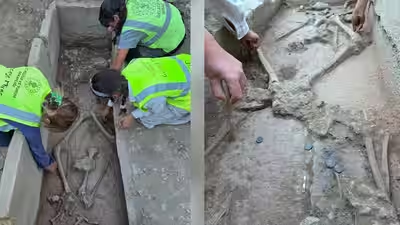
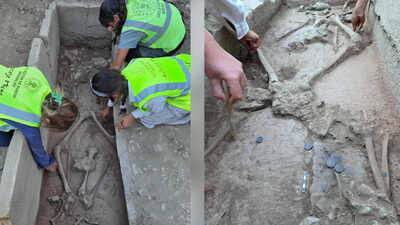
Archaeologists excavating near the ancient city of Aspendos in southern Turkey have uncovered a 2,400-year-old grave that may belong to a professional athlete, quite possibly a wrestler. The tomb, a box-style sarcophagus built from stone slabs, was found in a previously unknown cemetery outside the city and is believed to date to between 475 and 300 BCE, placing it firmly within Aspendos’s Classical period. Alongside the skeleton, archaeologists recovered several silver coins bearing the image of two wrestlers locked in combat, a design closely tied to the city’s identity in antiquity. Turkey’s minister of culture and tourism, Mehmet Nuri Ersoy, said the coins and other grave goods suggest the person buried there was connected to sport, and possibly competed as a wrestler himself, though experts caution the evidence remains far from conclusive.
Why Aspendos became linked to ancient wrestling and sport
Aspendos was a Greco-Roman city founded by Greek colonists in the fifth century BCE, sitting roughly 10 miles inland from Turkey’s Mediterranean coast. The city grew wealthy as a trading centre for salt, olive oil, wood and horses, and its prosperity eventually funded significant civic infrastructure built around sport and public life. Aspendos maintained a large Greek gymnasium and later built a stadium in the second century CE capable of holding up to 8,000 spectators, who gathered to watch footraces, javelin contests and wrestling matches. That civic investment in athletics helps explain why sport imagery became such a consistent feature of the city’s identity for centuries, long before the tomb now under study was ever built.
How wrestling imagery came to define the city’s own coinage
Aspendos is known above all for minting its own distinctive silver coins, called staters, which featured two naked wrestlers grappling on one side. According to a study titled Aspendian Wrestlers: An Iconographic Approach, published by numismatist Oğuz Tekin, the city struck these wrestler-type staters consistently throughout the fourth and third centuries BCE, with output and craftsmanship only declining toward the end of that period. The coins were minted for well over a century, a span long enough that many scholars, including Tekin, argue wrestling held genuine civic significance for Aspendos rather than functioning as a passing decorative choice on its currency.
What archaeologists actually found inside the newly excavated tomb
The grave was discovered within what officials are calling the Eastern Necropolis, a cemetery whose existence at Aspendos had never been documented before this excavation. Inside the stone sarcophagus, archaeologists found a single skeleton buried alongside the wrestler-decorated coins as well as other grave goods, though full details of every object recovered have not yet been released. Ersoy described the find as a significant discovery that helps illuminate the city’s Classical period history, noting that finds tied to this specific era of Aspendos have historically remained limited compared with better documented periods of the city’s later Roman development.
Why experts remain cautious about calling the remains a wrestler’s
Despite the striking coincidence between the coins and the deceased, outside experts have urged restraint before treating the identification as settled. Sarah E. Bond, a historian at the University of Iowa who was not involved in the excavation, said much more analysis would be needed before archaeologists could confidently identify the remains as belonging to a wrestler. She pointed out that these coins circulated widely and were used as everyday currency across the general population of Aspendos, not solely by athletes, meaning coins alone cannot establish someone’s profession. Physical evidence, such as a healed broken nose, a common injury associated with historical wrestling, could offer stronger clues, though whether such skeletal signs are present in this particular burial has not yet been confirmed publicly.
How this discovery fits into a larger pattern of finds at Aspendos
Researchers say the tomb forms part of an ongoing excavation effort that continues to reveal new details about daily life, burial customs and social structure in Classical-era Aspendos, a period of the city’s history that has so far been documented through comparatively limited archaeological evidence. Turkish officials have framed the discovery as part of a broader, continuing project to expand understanding of the city beyond its famous, well-preserved Roman theatre, which remains one of the best-known ancient theatres anywhere in the world. Each new find at the site, officials say, adds another piece to a still incomplete picture of how the city’s residents lived, competed and were remembered after death.
What this grave could still reveal about ancient athletic identity
Even without final confirmation, the tomb offers a rare, tangible link between an individual burial and the symbolic world of ancient sport that Aspendos so visibly celebrated on its coinage for generations. If further analysis does support the wrestler identification, it would represent an unusually direct connection between a named ancient sporting tradition and the physical remains of someone who may have taken part in it himself. For now, researchers are treating the coins as a compelling but not definitive clue, a reminder that ancient objects found beside a skeleton can point toward a story without fully confirming it, leaving the final identity of Aspendos’s mystery athlete an open question for future study.