In the early 2000s, Charlie Burrell and his wife Isabella Tree faced a difficult choice. After seventeen years of trying to farm 3,500 acres of heavy clay soil at Knepp Castle Estate in West Sussex, they were roughly 1.5 million pounds in debt, with intensive farming simply failing to turn a profit on land that was never suited to it. Instead of trying yet another farming method, the couple made a radical decision. They pulled down fences, stopped ploughing, and let free-roaming cattle, ponies, pigs and deer take over the land in place of crops and livestock as usual. What followed became Britain’s first large-scale lowland rewilding project, and nearly twenty-five years later, Knepp is now held up as proof of how quickly nature can recover once it is simply left alone.
Why Charlie Burrell and Isabella Tree gave up on farming at Knepp
Burrell inherited the Knepp estate from his grandparents at the age of 21 and spent the following seventeen years managing it using conventional intensive farming methods. The land’s dense clay soil made it consistently unprofitable, and by the turn of the millennium the couple were deep in debt with no clear path to making the farm financially viable. Inspired by a similar land restoration project already underway in the Netherlands, Burrell and Tree decided to abandon conventional agriculture entirely and instead let large grazing animals shape the landscape naturally, stepping back to see what would happen once nature was given room to take over.
How removing fences transformed the Sussex farmland
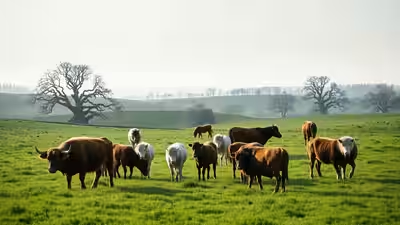
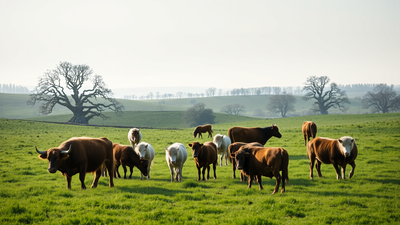
The transformation at Knepp began with simple but drastic changes. According to Knepp’s own review of the project, fences were pulled down, Victorian-era drainage systems were broken up to let natural water flow return, and dead trees were left standing rather than cleared away. Free-roaming longhorn cattle, Exmoor ponies, red and fallow deer and pigs were introduced as substitutes for the large herbivores that once shaped the British countryside, and their grazing and foraging created a shifting patchwork of grassland, scrub and wood pasture across the estate.This patchwork landscape turned out to be exactly what many struggling species needed. Wildlife surveys carried out on the estate found dramatic recoveries across multiple groups of animals, and researchers monitoring the project noted that the improvements have continued to build year after year rather than levelling off.
What the twenty-year review found at Knepp
The most detailed evidence of Knepp’s transformation comes from a two-decade ecological review of the estate. Knepp’s own published review reported a 900 per cent increase in breeding bird numbers alongside a 500 per cent rise in nightingales, birds that have declined sharply across much of the rest of the UK. Turtle doves, whose UK population has fallen by roughly 98 per cent since 1994, rose from just two singing males recorded at Knepp in 2008 to 22 in 2024. Butterfly species richness grew by more than 100 per cent in some parts of the estate between 2005 and 2025, and dragonflies and damselflies increased by close to 900 per cent over the same period.Rare species have also returned to the estate for the first time in decades or even centuries. White stork chicks hatched at Knepp in recent years, the first time this bird had bred successfully in Britain in hundreds of years, and beavers have taken up residence in Sussex waterways for the first time in around 400 years. According to the Zoological Society of London, scientists have also used more than two decades of satellite data to track habitat change across the estate from space, making Knepp one of the most closely monitored rewilding sites in the country.
Why Knepp has become a reference point for rewilding debates in Britain
Knepp’s success has made it central to wider conversations in Britain about how land should be managed and who benefits from rewilding. A study published in the journal PLOS ONE titled Everything under control? Comparing Knepp Estate rewilding project with ‘traditional’ nature conservation examined how rewilding at Knepp compares with more traditional, actively managed conservation approaches, noting that Knepp began from a low starting point of biodiversity as a former intensive farm, which gave the project more freedom to experiment without risking existing habitats. The same study observed that some conservationists have since pushed for more active management of certain habitats to support species like turtle doves and purple emperor butterflies, a suggestion that Knepp’s founders have largely resisted in favour of continuing to let natural processes drive change.
What Knepp shows about the future of rewilding
Nearly a quarter century after Burrell and Tree first pulled out the fences, Knepp stands as one of the most cited examples of what rewilding can achieve on land that was once considered a farming failure. Its influence has extended well beyond Sussex, shaping how conservationists, policymakers and landowners across Britain think about degraded farmland and its potential for recovery. As debates continue over how much control humans should exert over rewilded landscapes, Knepp’s own results, still climbing more than two decades in, continue to be treated as one of the clearest working examples of what letting go of a struggling farm can achieve for wildlife.