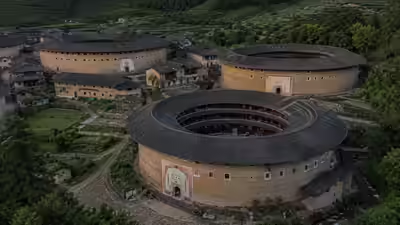
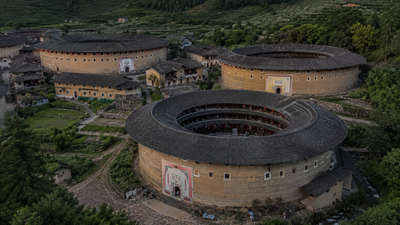
Seen from above, they resemble giant doughnuts carved into the landscape. From ground level, they look more like medieval fortresses than family homes. Their towering earthen walls, narrow entranceways and vast wooden interiors seem designed for defence rather than domestic life. Yet behind these imposing façades lies one of China’s most remarkable examples of communal living.Known as Fujian Tulou, these enormous earthen buildings housed entire clans for generations, bringing together grandparents, parents and children within a single structure. Built largely by the Hakka people in the mountains of Fujian Province, they combined security, practicality and social cohesion in a way that still feels surprisingly modern. Long before sustainable architecture became a design philosophy, the builders of the Tulou were creating homes that worked with the landscape, made clever use of local materials and fostered an extraordinary sense of community.
What are Fujian Tulou and why were they built as circular homes
The giant circular buildings scattered across the mountains of south-eastern China are known as Fujian Tulou, a name that simply means “earthen buildings”. While circular examples have become their defining image, not every Tulou follows the same blueprint. Some are square or rectangular, yet they all share the same underlying purpose: protecting and housing large extended families.According to UNESCO, the 46 Fujian Tulou inscribed on the World Heritage List were constructed between the 15th and 20th centuries, although the architectural tradition itself stretches back even further. Some of these immense buildings were capable of accommodating as many as 800 residents, effectively functioning as self-contained villages enclosed within a single set of walls.UNESCO aptly describes them as both “a little kingdom for the family” and “a bustling small city,” an unusually vivid description for a heritage listing, but one that captures their scale perfectly.The circular design was anything but decorative. In an era when rural communities could face attacks from bandits or rival groups, a Tulou offered protection without sacrificing daily life. Thick rammed-earth walls, a single heavily fortified entrance and few openings at ground level created a formidable defensive barrier. Inside, families could continue their routines with surprising normality while remaining sheltered from danger outside.Their location was equally deliberate. According to National Geographic, many Tulou were positioned according to traditional Feng Shui principles, balancing mountains, rivers and farmland to create settlements believed to exist in harmony with the natural landscape. UNESCO recognises them as an outstanding example of architecture that responds not only to human needs but also to its environment.
How hundreds of people lived together under one roof for centuries
A Fujian Tulou was never intended to be an ordinary house. It was designed as an entire community.Step through the heavy wooden entrance and the atmosphere changes instantly. Instead of narrow corridors or isolated rooms, visitors find a broad central courtyard surrounded by several storeys of timber galleries. The space feels open, almost village-like, despite being enclosed by towering earthen walls.Life followed a carefully organised rhythm. Kitchens and storage rooms usually occupied the ground floor, while upper storeys were reserved for bedrooms. The central courtyard became the social heart of the building, hosting family gatherings, celebrations, meetings and everyday conversations. Many Tulou also contained ancestral halls, communal wells and shared workspaces, allowing residents to meet nearly all of their daily needs without leaving the complex.Each branch of the extended family typically occupied a vertical slice of the building, with rooms stacked directly above one another. It was an elegant solution that ensured fairness while preserving family unity. Everyone had their own private space, yet no one lived in isolation.UNESCO notes that the Tulou embodies centuries of “communal living and defensive organisation”, and that description remains strikingly relevant today. At a time when loneliness has become a growing social concern in many parts of the world, these centuries-old buildings offer a fascinating reminder that architecture can shape the way people interact with one another.Their construction was equally ingenious. Built primarily from locally sourced rammed earth, timber, bamboo and stone, the exceptionally thick walls acted as natural insulation, keeping interiors cool during Fujian’s humid summers and retaining warmth through the colder months. The builders achieved comfortable living conditions using little more than natural materials and practical experience accumulated over generations.
Why Fujian Tulou remain one of China’s greatest architectural wonders
The enduring appeal of the Fujian Tulou lies not simply in their unusual appearance but in the remarkable balance they strike between engineering, sustainability and human relationships.In 2008, UNESCO designated the Fujian Tulou a World Heritage Site, recognising them as an exceptional example of communal housing, defensive architecture and harmonious settlement planning.Perhaps even more impressive is their longevity. Constructed from compacted earth rather than concrete or steel, many Tulou have withstood centuries of earthquakes, heavy rain and changing climatic conditions. Their resilience continues to attract architects, engineers and conservation specialists interested in traditional methods of sustainable construction.That interest has only grown as modern architecture increasingly searches for environmentally responsible solutions. The Tulou demonstrate that durable, climate-responsive buildings can be created using local materials, thoughtful planning and an understanding of place rather than technological complexity alone.Many of these extraordinary buildings remain inhabited today, while others have become cultural landmarks welcoming visitors from around the world. Walking through one is less like touring a historic monument than stepping into a living neighbourhood where architecture, family life and history have remained intertwined for centuries.The Fujian Tulou ultimately challenged a modern assumption that bigger communities require greater separation. Their builders imagined something different: a place where hundreds of people could live together, support one another and still feel at home. Centuries later, those giant circular walls continue to tell that story remarkably well.