
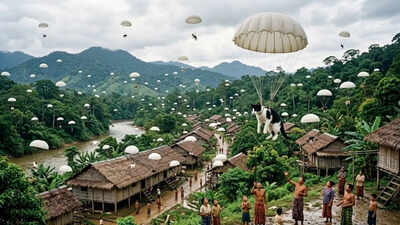
As the title suggests, Operation Cat Drop appears to be a fairy tale. However, it really took place in the 1950s when a series of bizarre occurrences in Borneo resulted in cats being dropped from aeroplanes. The whole incident started with an innocent intention to help solve an environmental issue that soon escalated into a catastrophe. This story seems interesting, but also amusing and demonstrates the potential dangers of human interference in nature. Now, let us briefly examine how and why the felines fell from the sky. It also highlights the importance of carefully evaluating ecological solutions before implementing them on a large scale.
‘Operation Cat Drop’ in Malaysia explained
The Operation Cat Drop took place in the 1950s in Sarawak, situated in Malaysia, which is an island nation known as Borneo. There was a malaria epidemic in the region that was due to the existence of mosquitoes. It was thought that the pesticide DDT would solve this mosquito problem.This strategy seemed promising as mosquitoes’ populations decreased and the number of cases of malaria fell. Nevertheless, DDT also had adverse effects and influenced various organisms. Thus, insects that were consumed by geckos were destroyed; the geckos themselves died because of the chemical, and consequently, the cats which consumed the geckos became victims.As stated in the research from the Department of Occupational and Environmental Health, University of Iowa, Iowa City, “the insecticide DDT accumulated in the food chain, leading to considerable ecological disturbance.” In addition, rats became numerous, with cats dying because of the poisoning.
Why were cats dropped from the sky
Due to the reduced number of cats, the population of rats increased dramatically. Such circumstances posed a real problem because rats could cause the outbreak of diseases, such as the plague and typhus. The ecosystem was unbalanced, and urgent actions had to be taken.The proposed decision may seem unconventional, but quite efficient: cats had to be introduced in the region once again. The process, however, was complicated because of the challenging geography. Therefore, an unprecedented strategy was elaborated: cats were put into crates and air-dropped into villages.Such an unconventional mission was called “Operation Cat Drop.” Cats were air-dropped to restore ecological equilibrium. Most of the animals landed in good condition and started to control the rat population almost immediately.It might seem strange, but it actually worked. The population of rats was reduced, and the diseases stopped spreading.
Lessons from Operation Cat Drop
Operation Cat Drop is commonly cited in ecology and environmental science texts. It provides an illustration of how meddling with nature, even with the best intentions, might result in unintended outcomes.For example, the use of DDT was intended to solve one problem, but it gave rise to other issues. As some scientists pointed out, “the complex systems of nature can react unpredictably to human tampering.” Such statements are relevant to today’s environmental discussions and pesticide utilisation.Moreover, Operation Cat Drop emphasises the significance of recognising food chains and ecological equilibrium. Disruption in one organism’s life can cause an imbalance elsewhere in the ecosystem.The case sounds amusing at first glance. However, it raises a vital question about the delicate balance of nature. Therefore, one should be careful while intervening with ecological processes.