
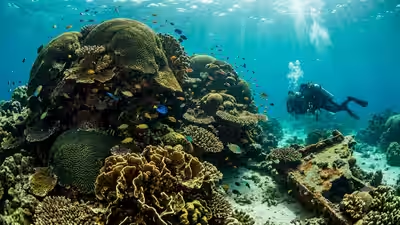
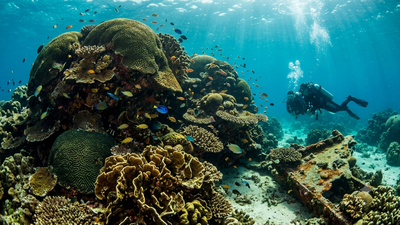
For years, Bikini Atoll has been associated with the destructive legacy of nuclear weapons testing. Stanford University reported that between 1946 and 1958, the United States detonated 23 nuclear devices across the Marshall Islands atoll, forcing its residents from their homes. The explosions left behind radioactive contamination that prevented permanent resettlement. Yet decades later, the waters around the abandoned atoll presented a very different picture. Marine biologists visiting the lagoon encountered fish, sharks and large colonies of coral. The corals were particularly striking because they could not simply move away from contaminated areas. Some appeared to have begun growing roughly a decade after the nuclear tests, raising questions about how they had managed to persist in an environment exposed to radiation.
23 US nuclear tests transformed Bikini Atoll and forced residents into exile
The US nuclear testing programme at Bikini Atoll began in 1946, shortly after the Second World War. Over the following 12 years, 23 nuclear devices were detonated there, radically altering the environment and displacing the island’s population. Residents were evacuated with the expectation that they would eventually be able to return. That did not happen. Radioactive contamination remained in the environment, affecting water, vegetation and other resources needed for permanent habitation.By the time marine biologists returned their attention to the atoll decades later, Bikini had become an unusual example of a place where the effects of nuclear testing remained part of the landscape long after the explosions themselves had ended.
Fish, sharks and large corals were found thriving around Bikini Atoll
Reportedly, a visit by Stephen Palumbi, director of Stanford University’s Hopkins Marine Station and a senior fellow at the Stanford Woods Institute for the Environment, revealed a marine environment that was far from lifeless.The lagoon contained fish and sharks, along with large coral colonies. The presence of coral was particularly significant because individual colonies can remain in one location and grow for many years. A fish or shark can move away from an unfavourable environment. Coral cannot.Some estimates placed the beginning of the surviving corals’ growth at around 10 years after the nuclear detonations. The colonies had established themselves relatively soon after the testing period and subsequently continued developing in waters affected by radioactive contamination.

Earlier coral tests offered a possible clue to Bikini’s surviving reefs
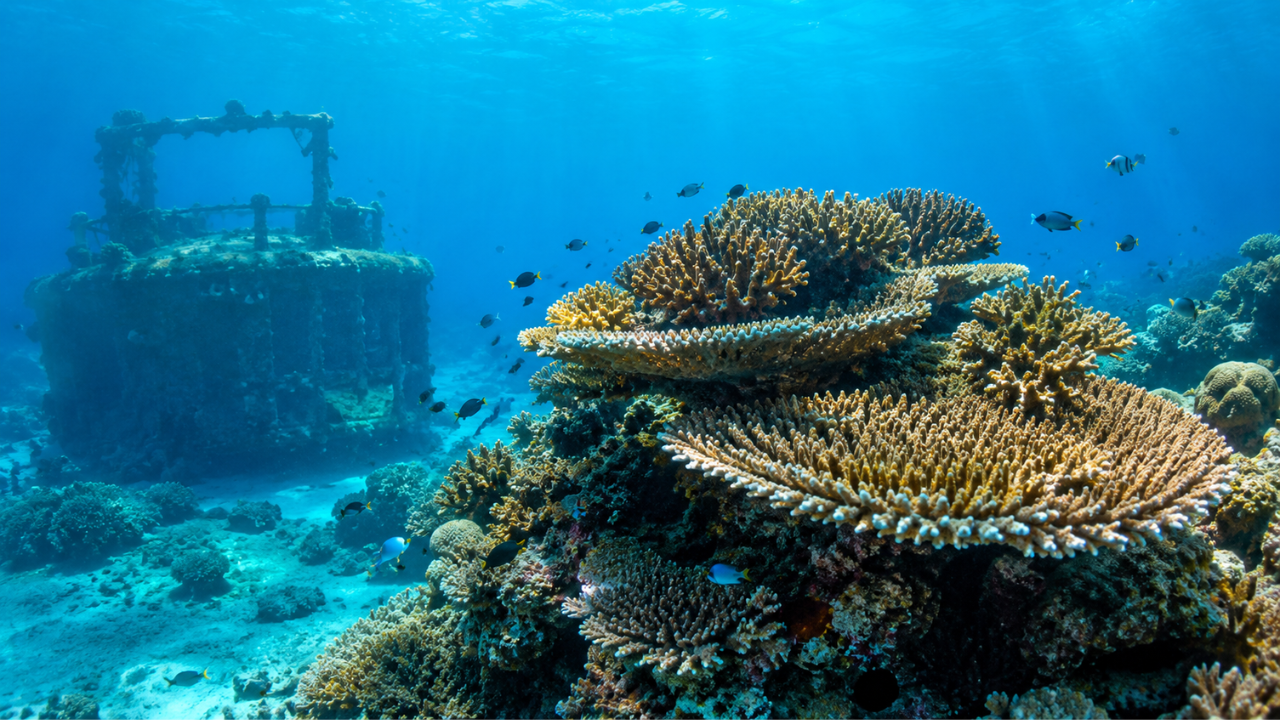
Palumbi had already been investigating how coral responds to environmental stress in other parts of the Pacific. His work included experiments involving coral from Samoa, where samples came from locations with different histories of nuclear runoff.The coral exposed to the nuclear-runoff environment behaved differently when tested under warmer-water conditions. In the reported experiments, that sample responded relatively normally, while coral from the comparison site showed a negative response to the increased temperature.The findings did not establish exactly why the Bikini corals were able to persist. Palumbi’s work instead pointed towards a possible explanation that required further investigation: populations living under prolonged environmental stress may, over generations, acquire characteristics that help them tolerate those conditions.
Bikini’s giant corals offered evidence of long-term survival
The size and apparent age of the Bikini corals mattered. Their presence could not easily be explained by a short-term return of marine life after the testing programme. Coral grows in place, building its skeleton over time. Large colonies therefore provided evidence that organisms had survived and developed in the lagoon across an extended period. Their persistence also contrasted with the continuing difficulties of human habitation on the atoll, where radioactive contamination remained a problem.The lagoon’s fish and sharks added to the picture, but the coral raised the more specific biological question. It was an organism that had remained exposed to the same broad environment rather than simply passing through it.
What radiation resistance could mean for biology
As reported, radiation can damage DNA, with mutations potentially leading to serious biological consequences including cancer. That makes organisms capable of tolerating prolonged exposure of particular interest to researchers.The Bikini observations did not show that coral was immune to radiation or that it had developed a mechanism that could be directly applied to humans. The research was still at the stage of trying to determine what had allowed these populations to survive.If the corals had developed biological mechanisms for dealing with radiation-induced damage, understanding those mechanisms could eventually contribute to research into DNA damage and cellular protection. Any such application would require substantial further research.